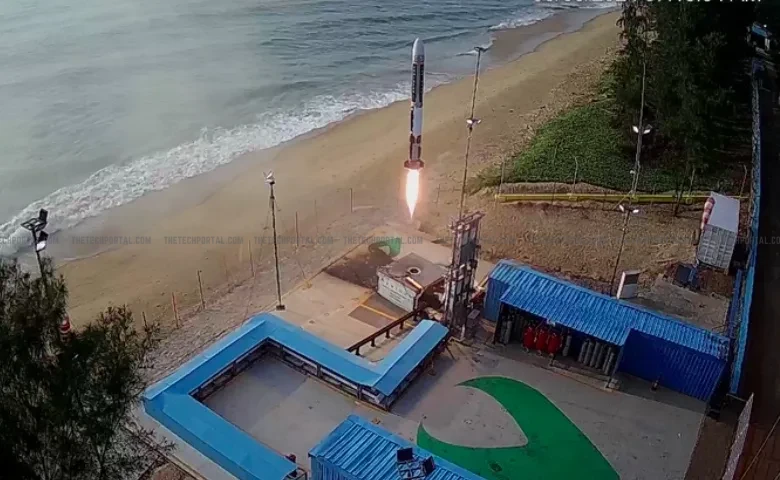
India's Agnikul Cosmos targets $75M raise at $500M valuation for 3D-printed rocket engines

Hardware
Originally reported by thetechportal.com
Chennai-based space-tech startup Agnikul Cosmos is in advanced talks to raise $50-75 million at a flat $500 million valuation, according to The Economic Times. The company, founded by Srinath Ravichandran and Moin SPM, has already raised over $75 million since 2017 from investors including Mayfield India, pi Ventures, and Celesta Capital. Agnikul is developing the Agnibaan small satellite launch vehicle, which uses its Agnilet engine - a single-piece 3D-printed semi-cryogenic engine built with LPBF technology. The company recently test-fired a cluster of three engines simultaneously and a larger one-meter-long booster engine, claiming it can now manufacture a complete rocket engine in approximately seven days.
This funding round places Agnikul within the aerospace qualification grind pattern, where additive manufacturing is used to compress production timelines for mission-critical hardware. The company's 3D-printed engine approach eliminates hundreds of traditionally assembled components, directly addressing the cost and lead-time constraints that have historically limited small launcher viability. Agnikul competes with Skyroot Aerospace, which recently crossed a $1 billion valuation, and is positioning itself for dedicated small satellite launches rather than rideshare missions - a market segment that demands rapid, customizable access to orbit. The company's revenue of approximately ₹9 crore ($1.1M) against losses of ₹43 crore ($5.2M) in FY24 underscores the capital-intensive nature of launch vehicle development, where technical milestones often precede commercial scale by several years.
From an AM industry perspective, Agnikul represents one of the most aggressive applications of metal LPBF to flight-critical propulsion systems outside of established players like Relativity Space. The company's ability to move from engine test to serial production will depend on qualification of its 3D-printed components under ISRO's certification framework and on scaling its planned 350-acre integrated manufacturing campus in Tamil Nadu. For investors, the flat valuation from the previous round suggests the market is pricing in execution risk rather than narrative premium - a sober signal for a sector where technical credibility does not automatically translate into commercial durability.
Topics