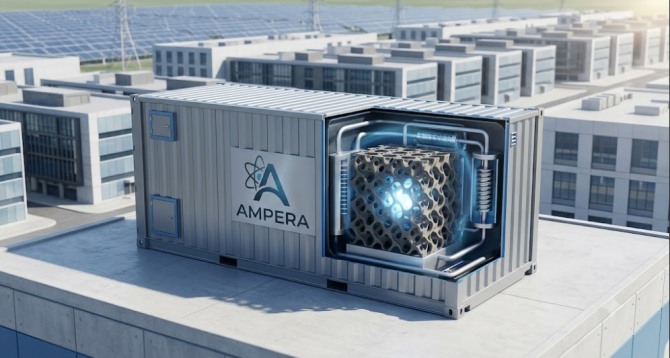
Ampera unveils 30MW SMR design combining 3D-printed silicon carbide core and thorium fuel for AI data centers

Hardware
Originally reported by g-enews.com
Silicon Valley-based energy startup Ampera has publicly disclosed a small modular reactor (SMR) design that integrates 3D-printed silicon carbide core structures with thorium fuel, targeting the AI data center power market. The 30MW system operates in a subcritical configuration, requiring an external accelerator to supply neutrons, which theoretically eliminates meltdown risk. Ampera claims its additive-manufactured monolithic core, built from silicon carbide rated above 3,000°C with a porous curved geometry to maximize heat transfer, can reduce reactor fabrication time to months once factory-scale production is established. The company has not yet filed for design certification with the U.S. Nuclear Regulatory Commission (NRC), and no pilot project or power purchase agreement has been announced.
This announcement sits at the intersection of two accelerating trends: the insatiable power demand from AI data centers and the growing interest in advanced nuclear as a carbon-free baseload option. Ampera's approach is notable for combining two unproven technologies - subcritical thorium operation and additively manufactured core internals - in a single regulatory package. The 3D-printed silicon carbide core is the most novel element from an AM perspective: if validated, it would represent one of the highest-temperature, most radiation-tolerant applications of additive manufacturing ever attempted. However, the NRC has no established framework for qualifying additively manufactured nuclear-grade components under prolonged radiation exposure, and competitors like TerraPower, Oklo, and X-energy have deliberately avoided such untested geometries, sticking with water-cooled or sodium-cooled designs built from conventionally fabricated materials. Ampera's "gas-first, nuclear-later" strategy - installing a supercritical CO₂ turbine for initial gas-fired operation, then swapping in the reactor module after regulatory approval - is a pragmatic hedge but does not reduce the core qualification burden.
The practical path forward for Ampera is narrow and long. The company must first secure NRC design certification, a process that historically takes 5–10 years even for conventional SMR designs. Simultaneously, it needs to generate long-term durability data for 3D-printed silicon carbide under high-radiation, high-temperature conditions - a materials qualification effort that has no precedent in nuclear regulation. At 30MW, the reactor is sized as a supplemental power source for a single large data center, not a primary grid asset, which limits its addressable market unless costs fall dramatically below the estimated $80–120/MWh LCOE range. For AM industry observers, the relevant question is not whether this design will commercialize by 2030, but whether the materials and process data generated during the qualification attempt will advance the broader case for additively manufactured nuclear components - a separate, slower, but potentially more consequential outcome.
Topics