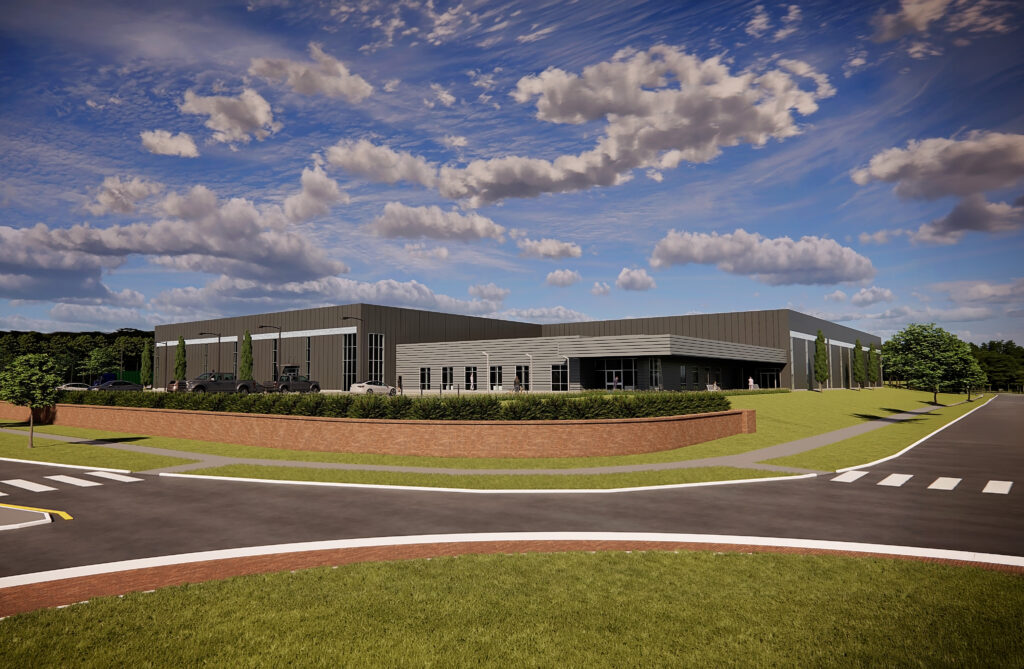
Auburn University breaks ground on $22M RFID lab as first phase of 45-acre advanced manufacturing research district
Originally reported by thebamabuzz.com
Auburn University has broken ground on a $22 million facility dedicated to its Radio Frequency Identification (RFID) Lab, marking the first phase of a planned 45-acre advanced manufacturing research district at the Auburn Research Park. The lab, scheduled to open by summer 2027, will support over 100 students and faculty alongside more than 35 R&D sponsors. Justin Patton, executive director of the RFID Lab, stated the expanded facility will enable simulation of complex supply chain environments and accelerate technology adoption. The project is a partnership between Auburn University, the Auburn Research and Technology Foundation, the City of Auburn, and the City's Industrial Development Board.
The significance of this development for additive manufacturing lies in the district's explicit inclusion of additive manufacturing among its target technologies, alongside automation, robotics, artificial intelligence, digital engineering, and advanced machining. This aligns with the broader industry pattern of university-led research parks serving as localized hubs for industrial AM adoption and workforce development. While the RFID Lab itself is not an AM facility, its role in supply chain sensor integration is directly relevant to AM production tracking and quality assurance in aerospace and retail logistics. The district's focus on reshoring and knowledge-based job creation mirrors the Chinese localization arc pattern in reverse - building domestic capability through academic-industry collaboration rather than cost-driven supply chain localization.
From an industry perspective, this facility represents a concrete investment in the research infrastructure that underpins AM qualification and serial production, particularly for aerospace and defense applications where traceability and supply chain visibility are critical. The practical outcome to watch is whether the district attracts anchor industrial partners who embed AM production lines alongside the RFID and sensor research, creating the kind of embedded supply-chain position that defines Tier S commercial lock-in. For now, this is a foundational investment in the substrate - the labs, talent pipeline, and collaborative frameworks - that will determine whether Auburn becomes a meaningful node in the US advanced manufacturing reshoring effort.
This article is an AI-assisted rewrite of the linked source report. Facts originate from the source; phrasing is AMPulse's. Use Read Original below to verify, or Report an issue if something is wrong.
Topics