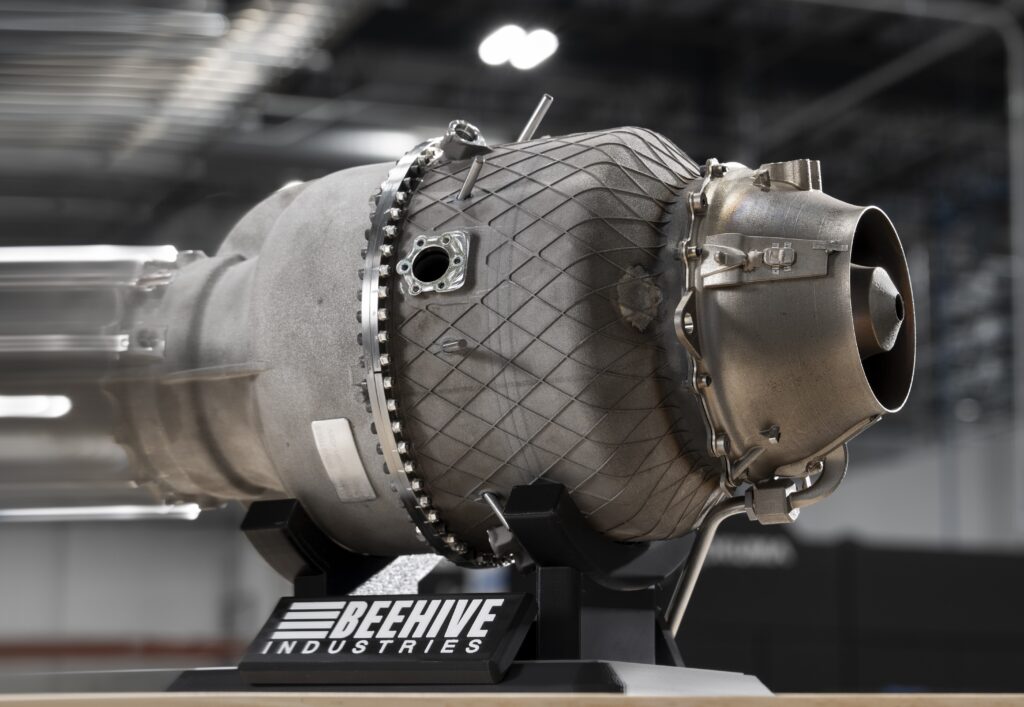
Beehive Industries orders 30 EOS M4 Onyx metal 3D printers for military drone engine production

Hardware
Originally reported by 3Druck
Beehive Industries has placed an order for 30 EOS M4 Onyx metal 3D printers, expanding its total EOS fleet to 50 systems. The machines will be delivered over the next twelve months to Beehive's facilities in Knoxville, Tennessee, and Centennial, Colorado. The investment is dedicated to scaling production of the Frenzy-8 engine family for unmanned aerial systems, including swarm-configured drones, where low unit cost and high throughput are critical. The order follows a $29.7 million U.S. Air Force contract for integration, flight testing, and qualification of the Frenzy-8, as well as altitude tests and flight readiness validation.
This expansion is a concrete signal that metal LPBF is moving beyond prototype and low-rate production into genuine series manufacturing for defense propulsion. Beehive is not a machine vendor or service bureau; it is an engine OEM that has embedded AM as its primary production process, which places it in a small cohort of companies that have crossed the qualification threshold for flight-critical hardware. The choice of the EOS M4 Onyx - a six-laser, large-format system with integrated process monitoring and powder handling - reflects a focus on repeatable factory output rather than single-machine heroics. The defense vertical is politically accelerated in 2025-26, and Beehive's ability to cite "unprecedented demand" from large defense programs aligns with the broader NDAA-driven push for domestic AM supply chains. The key editorial question is whether Beehive can turn this machine fleet into a reliable production engine, not just an impressive demo cell.
For the industry, this order validates that the value in AM is shifting from printer sales to production services embedded in qualified programs. Beehive's next challenge is maintaining quality consistency across 50 systems while ramping throughput for swarm-drone economics. The company must prove that its Frenzy-8 engine can be produced at scale without the per-unit cost inflation that often plagues AM serial production. If it succeeds, this becomes a reference case for defense primes evaluating AM for mission-critical propulsion. If it stumbles, it will reinforce the skepticism that AM still struggles with production repeatability.
This article is an AI-assisted rewrite of the linked source report. Facts originate from the source; phrasing is AMPulse's. Use Read Original below to verify, or Report an issue if something is wrong.