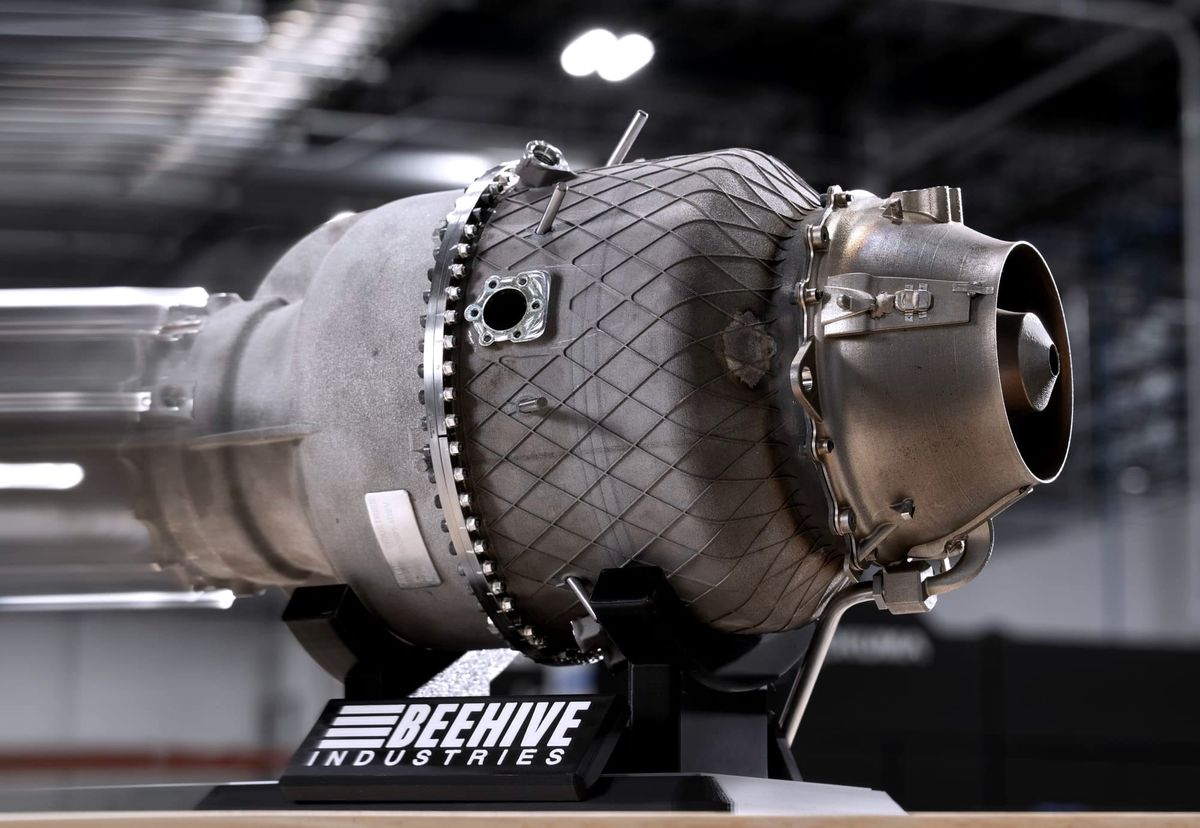
Beehive Industries invests $50M in 30 EOS M4 ONYX systems for defense engine production

Hardware
Originally reported by TCT Magazine
Beehive Industries, a propulsion systems manufacturer for uncrewed aerial systems, has committed $50 million to acquire 30 EOS M4 ONYX metal laser powder bed fusion (LPBF) systems. The machines will be installed over the next 12 months across the company's Knoxville, Tennessee, and Centennial, Colorado, facilities, more than doubling its total EOS fleet to 50 units. The investment follows the successful high-altitude testing of Beehive’s Frenzy 8 engine, a flight readiness validation, and a $29.7 million US Air Force contract for vehicle integration and qualification. COO and CFO Darius Ehteshami cited unprecedented demand from defense programs for affordable, high-rate production of uncrewed systems as the driver. The M4 ONYX, introduced in 2025, features a six-laser architecture, expanded build volume, and advanced process monitoring, which Beehive will pair with EOS software for real-time data tracking and quality management.
This acquisition is a layered signal for industrial metal AM adoption. On the surface, it is a straightforward capacity expansion-$1.67 million per machine for a multi-laser, large-format LPBF system-but the context matters more than the sum. Beehive is not a service bureau buying to resell hours; it is an engine OEM embedding AM as its primary production method, turning machine fleets into repeatable factories for a qualified, program-locked product. This fits the aerospace qualification grind pattern: Beehive validated the Frenzy 8 engine, secured a government contract, and is now scaling-not as a marketing headline about AM, but as infrastructure for a specific program. The choice of EOS over Chinese alternatives (BLT, Farsoon) also reflects the current NDAA-driven defense market bias, where domestic supply chains and proven qualification pathways carry a premium. The defense vertical is politically accelerated in 2025-26, and this $50 million bet confirms that the US Defense Department's push for domestic additive capacity is translating into real, multi-million-dollar equipment orders.
From an industry perspective, this deal moves beyond the early-adopter stage for defense AM. Beehive now operates one of the largest U.S. metal AM footprints for high-performance components, but the critical execution step is turning 30 machines into a repeatable production cell for a single engine line, not a general-purpose capacity pool. The partnership language from Beehive's President of Additive Parts Sales-praising EOS's willingness to "lean in" and partner on long-term growth-suggests that workflow integration and process stability mattered more than machine specs alone. For buyers evaluating LPBF for production, the takeaway is that vendor partnership depth and qualification support now outweigh raw laser count or build volume as selection criteria.
This article is an AI-assisted rewrite of the linked source report. Facts originate from the source; phrasing is AMPulse's. Use Read Original below to verify, or Report an issue if something is wrong.