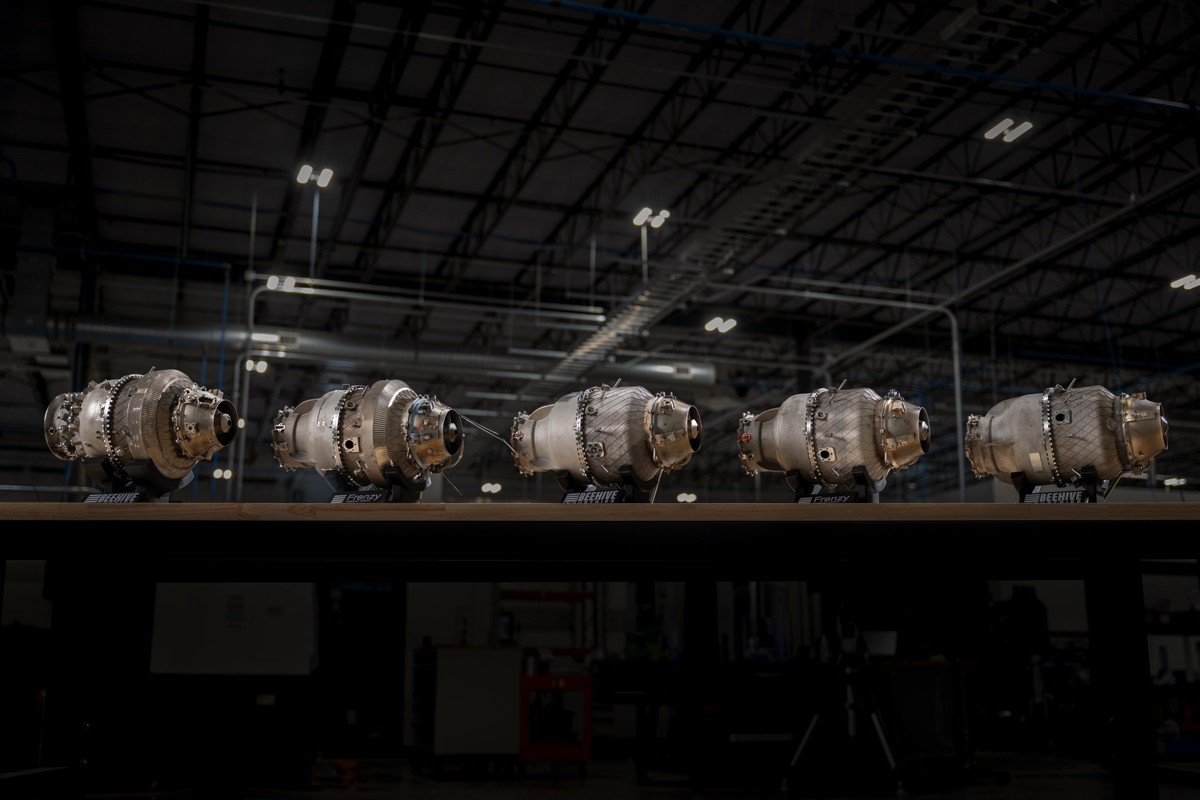
Beehive Industries wins USD 29.7M U.S. Air Force contract to advance 3D-printed jet engine production

Hardware
Originally reported by ShareLab
Beehive Industries has secured a USD 29.7 million contract from the U.S. Air Force, awarded through the Air Force Life Cycle Management Center and the SOSSEC Consortium. The funding will accelerate development and production of the company's Frenzy 8 engine, a 200-pound-thrust class jet engine designed for unmanned systems, along with continued work on the 100-pound-thrust Frenzy 6. The contract covers airframe integration, flight testing, and certification, with Beehive targeting serial production start within 2026. The company has already completed ground and high-altitude tests on the Frenzy 8 and is validating manufacturing scale through its Pathfinder program.
This award places Beehive at the center of the U.S. Department of Defense's FAMM (low-cost mass-capability weapons) strategy, which explicitly seeks to replace expensive, low-volume platforms with expendable, mass-produced systems. The Frenzy engines are designed for swarm drones and one-way-attack munitions, a mission profile that demands radically different cost structures than traditional aircraft engines. Beehive's use of additive manufacturing compresses the supply chain by consolidating hundreds of conventionally machined parts into single printed assemblies, directly addressing the military's requirement for low cost, short lead times, and production scalability. This is a textbook case of the defense vertical's politically accelerated adoption wave, where AM is not a prototyping tool but the enabling production technology for an entirely new class of weapon system.
From an AM industry perspective, this contract validates that metal AM can meet the cost and volume requirements of expendable turbine engines, a segment where qualification cycles are compressed by mission urgency rather than stretched by commercial airworthiness standards. Beehive must now execute on its 2026 production timeline and demonstrate that its AM-based supply chain can deliver consistent quality at the scale the Air Force expects. For competitors in the small turbine space, the bar has been raised: the winning approach will be measured not by thrust-to-weight ratios alone, but by the ability to print, test, and deliver engines at a unit cost that makes single-use viable.
This article is an AI-assisted rewrite of the linked source report. Facts originate from the source; phrasing is AMPulse's. Use Read Original below to verify, or Report an issue if something is wrong.