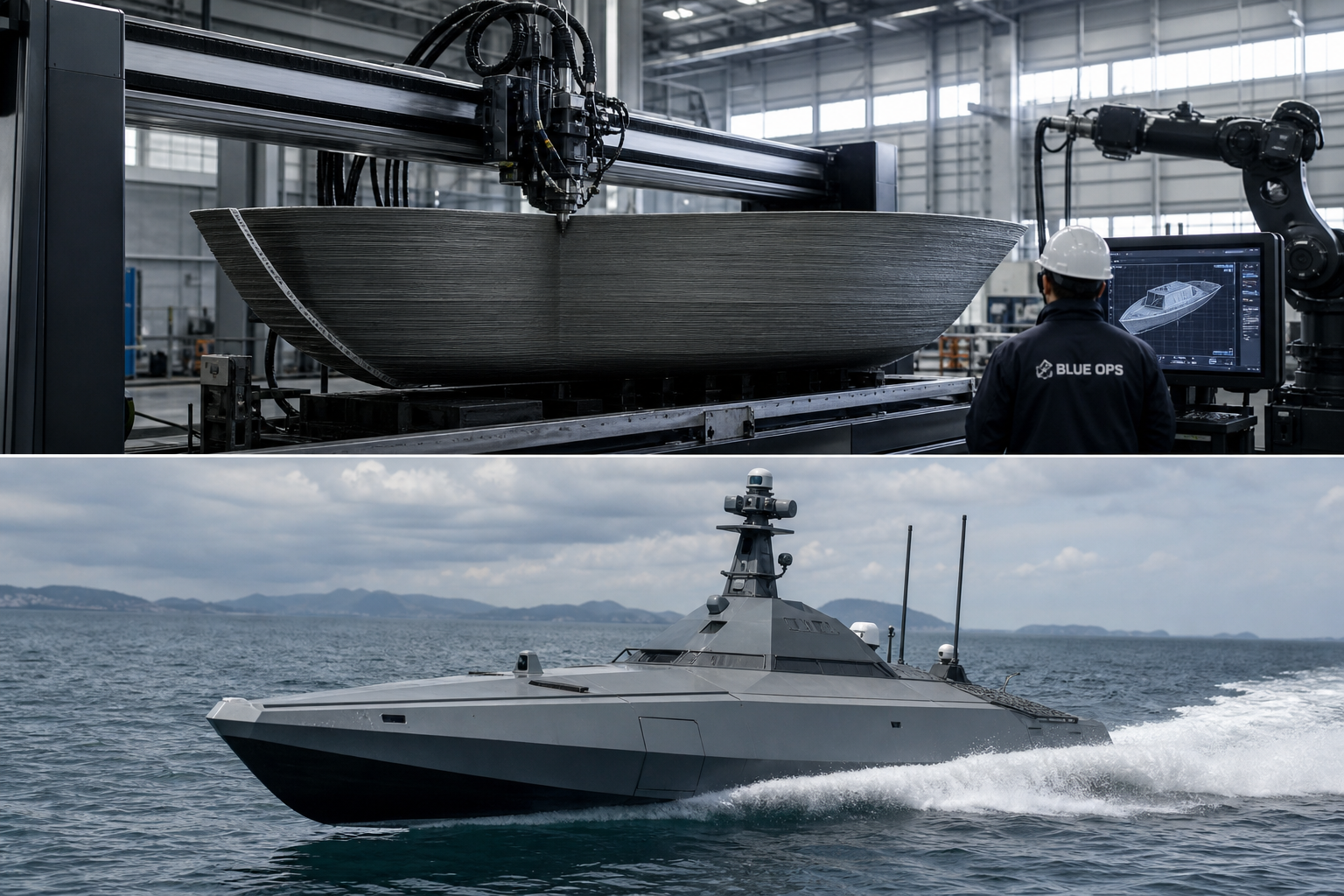
BlueOPS partners with Haddy for AI-driven 3D printed unmanned naval vessels

Application
Originally reported by dailydefense.co.kr
BlueOPS, a subsidiary of RedCat Holdings, has entered a strategic partnership with additive manufacturing firm Haddy to produce unmanned surface vessels (USVs) using AI-driven robotic 3D printing systems. Announced in early April 2026 and reported by Janes on May 5, the collaboration integrates Haddy's automated production platform into BlueOPS' manufacturing facilities. Barry Hinkley, president of BlueOPS, described the potential impact as comparable to the historical shift from wooden to fiberglass hulls, emphasizing the ability to rapidly iterate designs and produce vessels on demand near operational theaters.
This partnership targets the defense vertical, specifically the emerging market for unmanned naval platforms, where production speed and supply chain resilience are critical. BlueOPS is leveraging Haddy's distributed small-factory network to enable decentralized manufacturing, reducing logistics burdens and delivery times for military customers. The move aligns with the broader defense sector's push toward additive manufacturing for mission-critical hardware, accelerated by policy shifts like the NDAA §849 split effective late 2026. While large-scale metal additive manufacturing for naval vessels remains nascent, this application of polymer or composite 3D printing for USVs could lower barriers to rapid fleet expansion, though the technical readiness of Haddy's system for marine-grade structures remains unverified.
For BlueOPS, the immediate challenge is transitioning from concept to qualified production, including material certification for saltwater environments and structural integrity under combat loads. The partnership's success hinges on demonstrating that Haddy's AI-driven process can consistently produce vessels meeting military standards, not just prototypes. Buyers should view this as a promising but early-stage capability, with meaningful production volumes likely years away pending validation trials.
This article is an AI-assisted rewrite of the linked source report. Facts originate from the source; phrasing is AMPulse's. Use Read Original below to verify, or Report an issue if something is wrong.
Topics