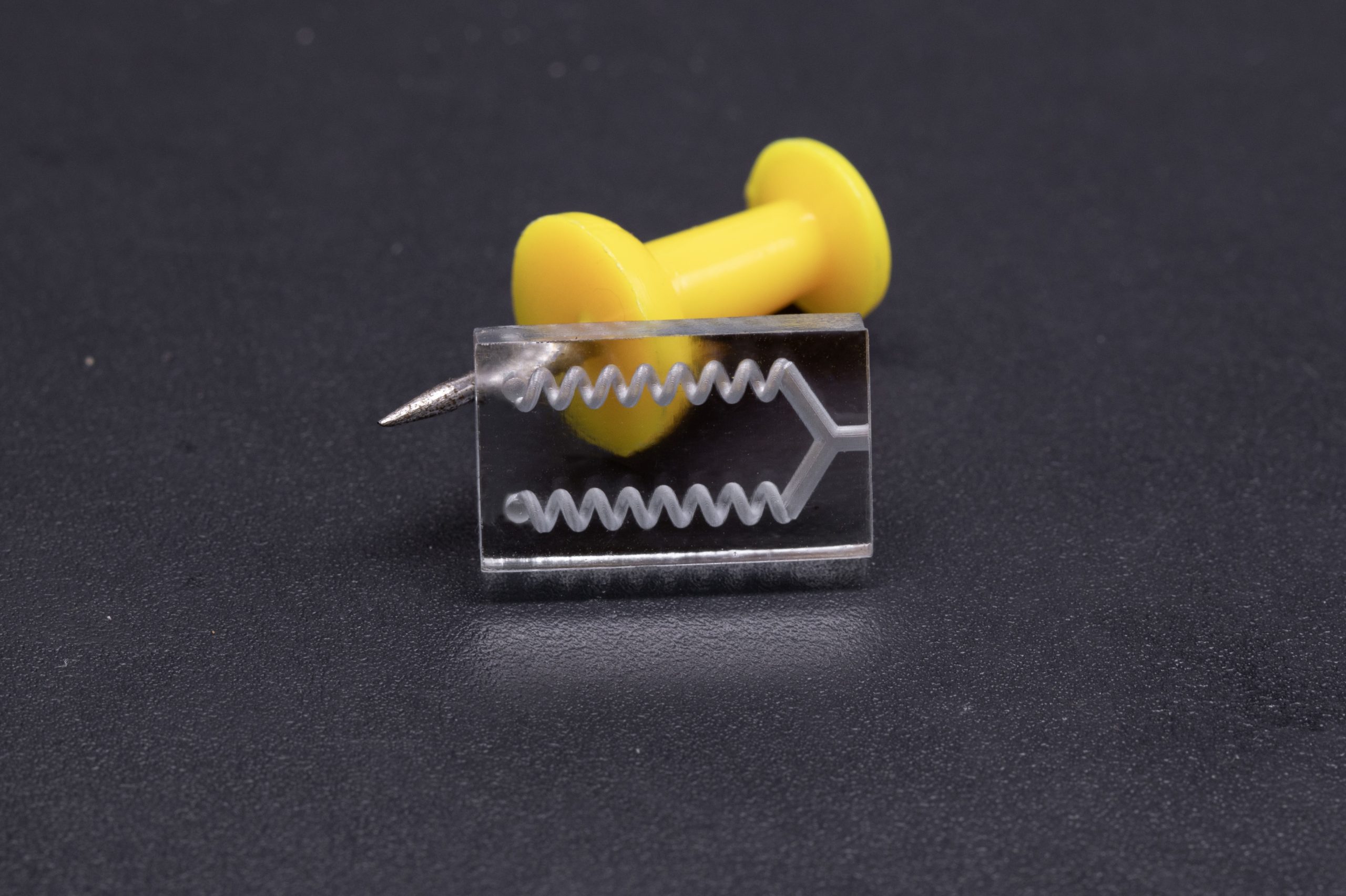
Boston Micro Fabrication launches BMF Clear photopolymer resin with >90% light transmittance for micro 3D printing

Hardware
Originally reported by 3D Printing Industry
Boston Micro Fabrication (BMF), a Massachusetts-based manufacturer of micro-precision 3D printers, has introduced BMF Clear, a photopolymer resin achieving greater than 90% light transmittance. The material is designed exclusively for BMF's projection micro stereolithography (PµSL) platforms operating at 10µm and 25µm resolution, including the newly launched microArch S150 series. BMF Clear prints at layer heights between 10 and 50µm and has passed biocompatibility testing for skin irritation, sensitization, and in vitro cytotoxicity, enabling use in biomedical devices such as endoscopic systems, intraocular tools, and minimally invasive drug delivery components. CEO John Kawola stated the resin targets applications where optical transparency and micron-level accuracy are required simultaneously, including microfluidics, fiber optic components, waveguides, and advanced sensors.
This launch addresses a persistent gap in polymer AM: combining true optical clarity with the surface finish and feature resolution needed for functional micro-optics and lab-on-a-chip devices. Most commercial transparent resins scatter or diffract light at small feature sizes due to surface roughness, limiting their utility in applications where internal channels must be optically monitored or where freeform micro-lenses must transmit light at specific wavelengths. By pairing the resin exclusively with its own high-precision PµSL platforms, BMF is signaling that the optical performance specification is as much a function of the printing process as the material chemistry - a move that reinforces the company's position in the high-value, low-volume micro-additive manufacturing niche. This segment, which serves medical device prototyping, microfluidics R&D, and photonics, remains distinct from the broader polymer AM market dominated by SLA, DLP, and material extrusion systems that prioritize speed or cost over micron-level precision.
For BMF, the practical challenge is converting this technical capability into recurring material sales and platform lock-in within a niche that values precision but is price-sensitive at scale. The biocompatibility certification is a necessary but not sufficient condition for medical adoption; customers will need to validate the material against their specific sterilization and long-term stability requirements. This is a targeted product extension that strengthens BMF's value proposition for existing microArch users and may attract new buyers in photonics and biomedical R&D, but it does not change the competitive structure of the broader polymer AM market.
This article is an AI-assisted rewrite of the linked source report. Facts originate from the source; phrasing is AMPulse's. Use Read Original below to verify, or Report an issue if something is wrong.
Topics