University of Groningen researchers use BMF microArch S240 to 3D print seal-whisker-inspired MEMS flow sensors with sub-10µm resolution

Hardware
Originally reported by 3DPrint.com
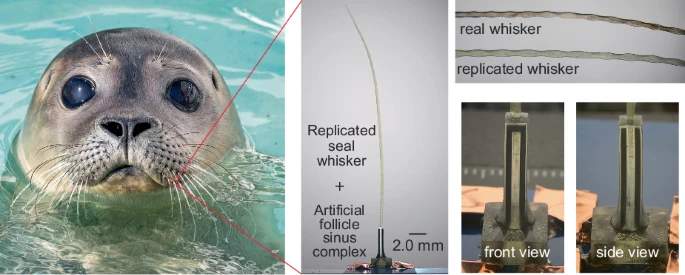
Researchers at the University of Groningen have developed a fully 3D-printed MEMS flow sensor inspired by seal whiskers, using Boston Micro Fabrication's (BMF) microArch S240 system. The team, led by Engincan Tekin, Ming Cao, and Ajay Giri Prakash Kottapalli, published their work in Nature Microsystems and Nanoengineering. They created a custom elastomeric resin-a 70:30 blend of a PDMS-like resin and BMF's UTL material-to print an artificial follicle-sinus complex in a single step at sub-10µm resolution. After printing, graphene nanoplatelet ink was infused into internal channels to create a piezoresistive sensor that reliably detected hydrodynamic vortex trails over 3,000 cycles, mimicking how seals track prey through water disturbances.
This work is significant for BMF because it demonstrates that its Projection Micro Stereolithography (PµSL) platform can serve as a manufacturing tool for integrated MEMS devices, not just passive micro-scale components. The ability to print a compliant structure and sensor channels in one step, then functionalize with conductive ink, points toward a production workflow that bypasses traditional cleanroom MEMS fabrication for certain low-to-mid volume applications. For the broader AM industry, this is a concrete example of additive manufacturing moving into the micro-device frontier-a segment where conventional MEMS fabrication carries high upfront tooling costs and long lead times. The research also opens a path for soft robotics and underwater sensing applications, though these remain at the lab stage.
From a practical standpoint, BMF's value here is in resolution and material compatibility rather than throughput or scale. The microArch S240 is a niche tool for precision research and micro-production, and this application reinforces its position in that corridor. The real test will be whether the team can transition from a single-material, single-step proof-of-concept to a repeatable process with consistent piezoresistive performance across batches. For now, this is a strong academic validation of BMF's platform for bioinspired MEMS, but it does not yet signal a commercial sensor product or a shift in BMF's market trajectory.
Topics