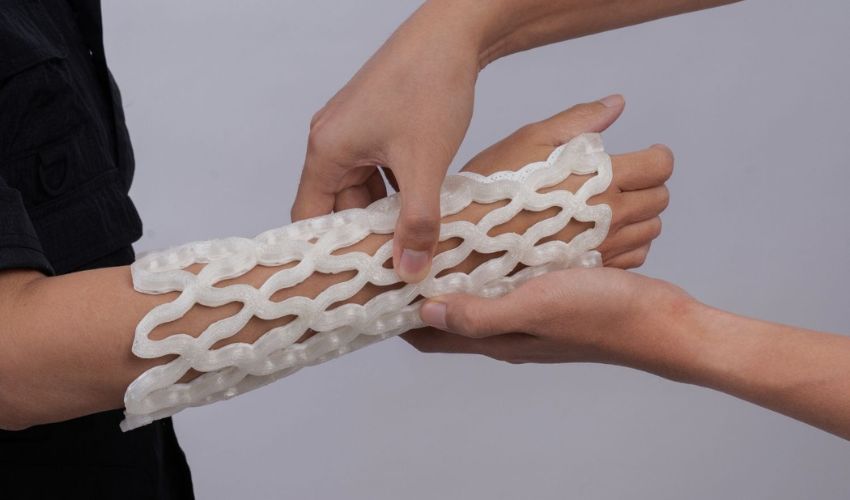
Castomize launches 4D-printed orthopedic brace that replaces plaster casts with heat-moldable smart polymer

Hardware
Originally reported by 3DNatives
Singapore-based startup Castomize has commercialized a 4D-printed orthopedic brace that uses a smart thermoplastic to replace traditional plaster and fiberglass casts. The device emerges from research at the Singapore University of Technology and Design and entered the market in 2022. Castomize currently offers braces for wrist, forearm, arm, and ankle in standard sizes that clinicians heat, mold directly onto the patient's anatomy, and let cool - no pre-scan, no saw for removal. The open-lattice structure provides breathability, waterproofing, and weight reduction; the company claims patients can swim while wearing the brace with medical approval. Castomize is expanding into pediatric sizes and veterinary prosthetics.
This product sits at the intersection of polymer material extrusion and clinical workflow simplification, a rare instance of 4D printing - where a printed structure changes shape in response to an external stimulus - reaching a commercial medical product rather than remaining a lab demonstration. The brace bypasses the typical digital workflow bottleneck in medical-dental AM: it does not require patient-specific 3D scanning or custom design per individual, relying instead on post-print heat forming of standard sizes. This lowers the adoption barrier for clinics that lack in-house scanning and design capability. The key engineering challenge Castomize solved is selecting a thermoplastic that softens at a safe, clinically practical temperature and retains its new shape reliably through the healing period. The product competes with conventional casting materials and with custom 3D-printed orthoses from service bureaus, but its re-moldability - the clinician can reheat and adjust the same brace as swelling subsides - gives it a practical advantage over single-shot custom prints.
From an AM industry perspective, Castomize's brace is a modest but instructive product: it demonstrates that 4D printing can deliver real clinical utility when the material science is matched to a specific, high-volume workflow gap. The company's next hurdle is scaling production and building clinical trust - orthopedic surgeons are conservative adopters, and the brace must survive comparative studies on healing outcomes, skin health, and cost versus plaster. For now, Castomize has a defensible niche: a re-moldable, waterproof, ventilated cast that eliminates the saw and the itch, sold as a standard medical device rather than a custom digital service.