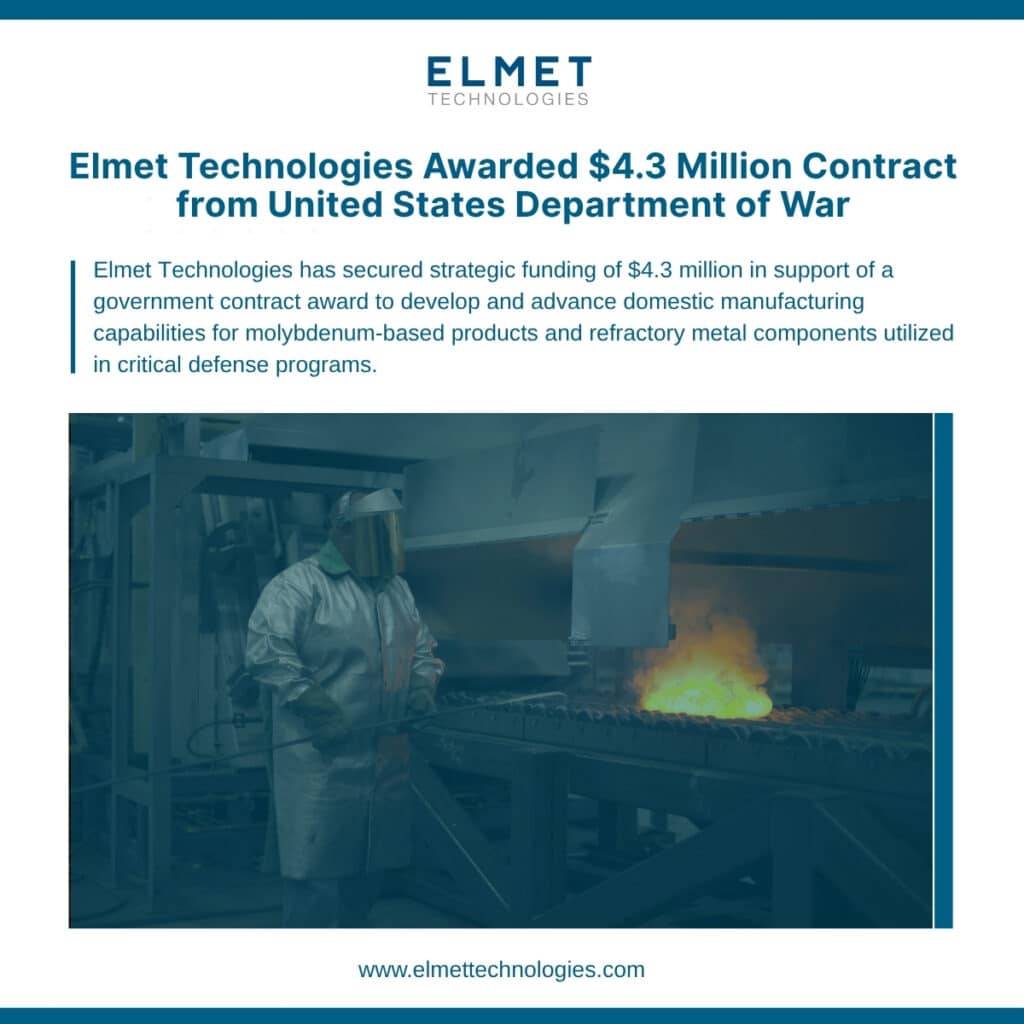
Elmet Technologies Receives $4.3M Defense Award to Scale Molybdenum AM Production

Materials
Originally reported by 3D Printing Industry
Elmet Technologies, the Lewiston, Maine-based subsidiary of The Elmet Group, has secured a $4.3 million contract from the United States Department of War to expand its production of molybdenum-based components and other refractory metal parts for defense applications, with a specific focus on interceptor systems. The funding will be deployed across precision machining, automation, and additive manufacturing equipment, as well as material feeding, post-processing, finishing, and inspection capabilities. President Derek Fox stated the award directly supports the mission of securing critical materials and components supply chains in the U.S., enabling the company to expand capacity and deploy advanced manufacturing technologies for defense initiatives that depend on molybdenum-based components.
This award fits a clear pattern in the defense vertical: the U.S. is actively funding domestic refractory metal supply chains to reduce dependence on foreign sources, particularly China, which dominates global tungsten and molybdenum supply. Elmet positions itself as the only vertically integrated tungsten and molybdenum manufacturer under full U.S. ownership, making it a natural beneficiary of this policy push. The funding parallels similar moves by 6K Additive, IperionX, and Amaero, all of which have received defense contracts to build domestic capacity for critical materials like titanium, tungsten, and niobium. For metal AM specifically, this award signals that defense primes are increasingly willing to fund upstream material production and AM integration as part of broader supply chain resilience programs, rather than treating AM as a standalone technology investment.
From a practical standpoint, Elmet must now execute on the equipment upgrades and demonstrate that its vertically integrated model can deliver consistent throughput for interceptor-grade components. The $4.3 million is modest relative to the scale of the domestic refractory metal gap, but it provides a clear test case for whether a single-site, U.S.-owned producer can serve as a reliable alternative to foreign supply chains. For defense buyers, the key question is whether Elmet can achieve the qualification and repeatability standards that primes require for mission-critical refractory parts, not just produce them at higher volume.
This article is an AI-assisted rewrite of the linked source report. Facts originate from the source; phrasing is AMPulse's. Use Read Original below to verify, or Report an issue if something is wrong.
Topics