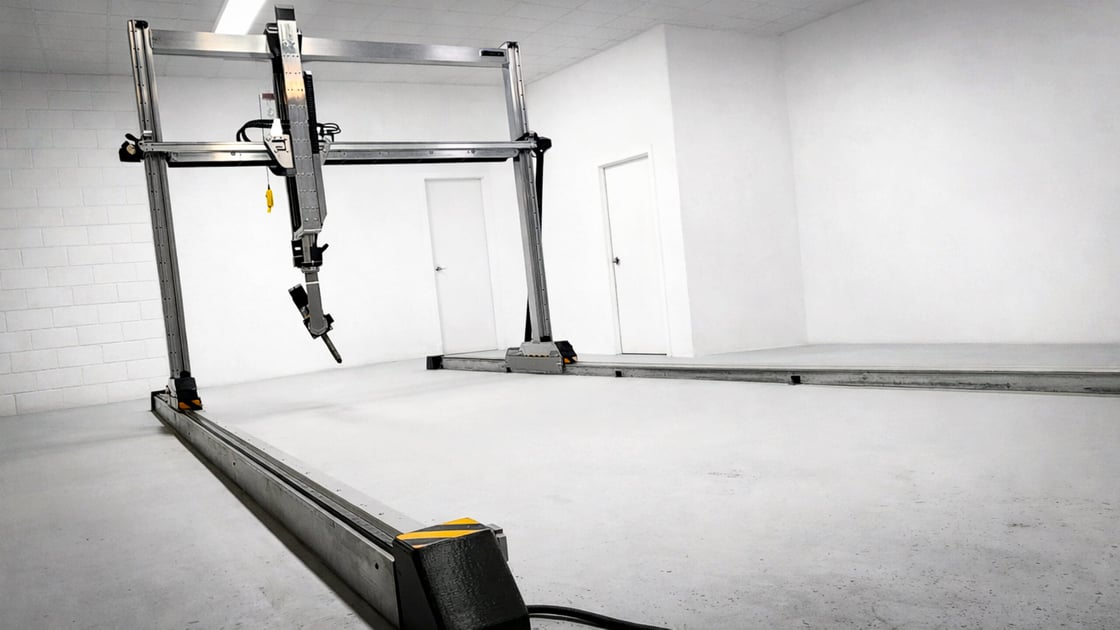
ErectorBot integrates Aibuild software to make large-format 3D printing as easy as desktop printing

Hardware
Originally reported by All3DP
ErectorBot, a US-based manufacturer of large-format polymer extrusion systems, has integrated Aibuild's print-preparation and workflow software across its machine lineup. The partnership, announced May 12, 2026, targets ErectorBot's systems starting at $15,000 - a price point that undercuts most industrial-scale FDM/FFF platforms by an order of magnitude. The integration aims to automate slicing, support generation, and print-path optimization for build volumes exceeding one cubic meter, a segment where manual G-code tuning has historically been a barrier to entry for smaller manufacturers.
This move directly addresses a persistent friction point in the polymer-mex segment: the gap between desktop ease-of-use and industrial-scale complexity. ErectorBot competes with BigRep, Modix, and 3D Systems' Figure 4 line in the sub-$50,000 large-format space, but its $15,000 entry price and Aibuild's cloud-native toolpath engine create a differentiated value proposition. The AMPulse framework identifies this as a classic IP lock-in grind (P3) play: by embedding Aibuild's software into its hardware workflow, ErectorBot builds switching costs through customer workflow dependency, while simultaneously lowering the qualification burden for first-time industrial buyers. The industrial-tooling and automotive verticals - both heavy users of large-format tooling and fixtures - are the most likely early adopters, given their sensitivity to both cost and setup complexity.
For ErectorBot, the execution risk is now in the field: can its support network and material profile library match the reliability that desktop users expect? Aibuild's software is proven in aerospace and automotive production environments, but ErectorBot's customer base skews smaller and less experienced. The practical test will be whether first-time users can achieve first-layer adhesion and dimensional accuracy on a 1m³ part without iterative manual tuning. If the integration delivers on that promise, it could expand the addressable market for large-format polymer AM beyond the current specialist base.
Topics