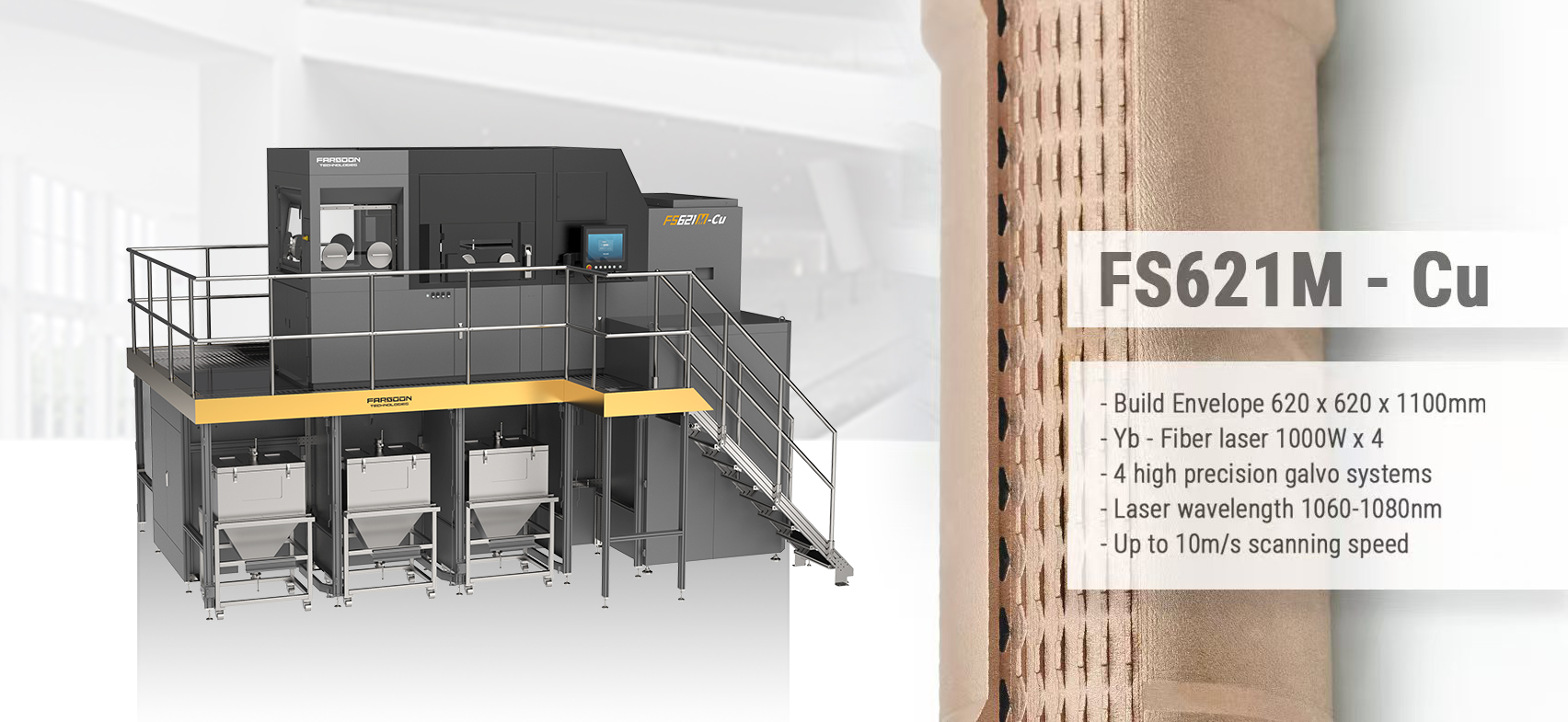
Farsoon achieves 42 cm³/h build rates for CuCrZr copper alloy using FS621M-Cu and FS273M platforms

Hardware
Originally reported by 3D Printing Industry
Farsoon Technologies has announced technical advancements in copper alloy Laser Powder Bed Fusion (LPBF), specifically targeting the high reflectivity challenges of CuCrZr and pure copper. The company's FS273M platform utilizes a 55 μm laser spot and 20 μm layer thickness to achieve feature resolutions as fine as 0.2 mm, enabling the production of ultra-thin cooling fins and TPMS structures. For larger scale applications, the FS621M-Cu system employs four 1000W ytterbium fiber lasers to maintain process stability, achieving build rates of up to 42 cm³/h with an 80 μm layer thickness and part densities reaching 99.5% via Archimedes measurement.
These developments address a critical bottleneck in metal additive manufacturing where the high thermal and electrical conductivity of copper alloys often leads to melt pool instability and porosity. While competitors like Eplus3D are exploring red-laser technology for meter-scale parts, Farsoon is focusing on the intersection of high-speed throughput and micron-level precision. This positioning is vital for the electronics thermal management and aerospace sectors, where high-density copper components are required for heat exchangers and advanced energy systems. By stabilizing the process window for CuCrZr, Farsoon is moving copper AM from experimental laboratory settings into high-stakes industrial production environments.
For end-users in the energy and electronics sectors, the ability to print complex, thin-walled geometries like 0.18 mm features without secondary machining is the primary value driver. The success of the FS621M-Cu in recent energy research deployments suggests the hardware is ready for production-grade electrode and heat sink manufacturing. Buyers should evaluate these systems based on the specific thermal conductivity requirements of their applications, as Farsoon is reporting pure copper conductivity up to 388 W/(m·K).
This article is an AI-assisted rewrite of the linked source report. Facts originate from the source; phrasing is AMPulse's. Use Read Original below to verify, or Report an issue if something is wrong.