Farsoon qualifies ALM polymer powders and launches PEBA SLS process for robotics and footwear

Hardware
Originally reported by 3D Printing Industry
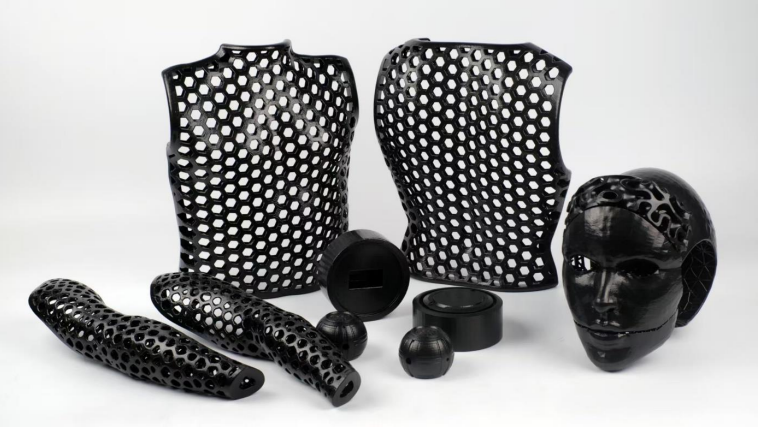
Farsoon Technologies has expanded its open polymer powder bed fusion ecosystem by qualifying three industrial materials from EOS subsidiary Advanced Laser Materials (ALM): HT-23, a PEKK-based carbon-fiber blend positioned as a direct Ultem replacement; PA 850 Black, a bio-based polyamide melting at approximately 185°C; and FR-106, a flame-retardant material passing the FAR 25.853 vertical burn test with tensile strength up to 44 MPa. All three powders run on Farsoon’s 1001P, 601P, 403P, and 252P SLS systems. Separately, Farsoon unveiled a two-step PEBA production process combining SLS printing with a physical foaming step, achieving densities as low as 0.03 g/cm³ and weight reductions up to 70% versus conventional TPU, alongside energy return above 85% and over 200,000 cycles of 90-degree bending durability. The PEBA process targets auxetic lattice structures for robotics collision systems and custom footwear production at roughly 12 minutes per pair without injection molding tooling. Both announcements were made ahead of TCT Asia 2026.
This dual move addresses two structural gaps in polymer AM. The ALM partnership strengthens Farsoon’s open-platform strategy-a direct counter to the closed-material models of EOS and HP-by adding high-temperature PEKK and flame-retardant grades that unlock aerospace and rail interior applications, verticals where regulatory qualification (FAR 25.853) creates meaningful switching costs. The PEBA process, meanwhile, targets the fast-growing flexible and elastomeric AM segment, where TPU and photopolymer resins dominate but struggle with weight and fatigue performance. By combining SLS with a post-print foaming step, Farsoon effectively creates a new process category that competes with injection molding for low-to-mid volume production in robotics and footwear-two demand verticals where customization and lightweighting are primary purchase drivers. The open-platform approach also lowers the barrier for third-party material suppliers, accelerating the material ecosystem without requiring Farsoon to develop every grade internally.
For Farsoon, the practical challenge is execution: the PEBA process requires customers to adopt a two-step workflow with specialized foaming equipment, which adds process complexity and capital cost. The ALM materials, while qualified, still need end-user qualification cycles in aerospace and rail before they displace incumbent materials like Ultem. Buyers evaluating Farsoon’s polymer systems should verify that the PEBA foaming step is available as a turnkey solution-not just a lab demonstration-and that the ALM powders carry the same traceability and batch consistency required for regulated applications. This is a solid incremental expansion of Farsoon’s addressable market, not a market-shaping event, but it reinforces the company’s position as the leading open-platform alternative in industrial polymer SLS.
This article is an AI-assisted rewrite of the linked source report. Facts originate from the source; phrasing is AMPulse's. Use Read Original below to verify, or Report an issue if something is wrong.
Topics