FlashForge Patents Elastic Coupling for Smoother FFF Toolhead Docking

Hardware
Originally reported by Fabbaloo
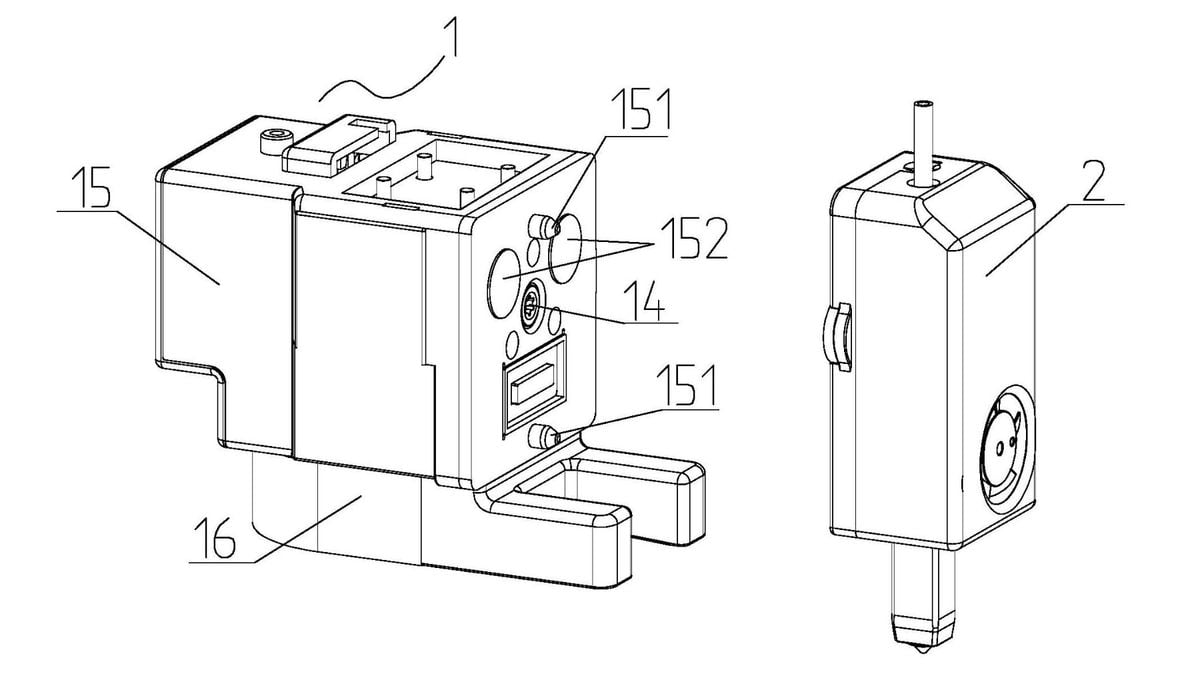
FlashForge has been granted Chinese utility model CN224426517U for a printhead assembly designed to improve docking reliability in multi-material FFF systems. The patent, assigned to Zhejiang FlashForge Group Co., Ltd. and granted on June 30, 2026, describes a shared-drive architecture where a single motor and reduction gearset on the moving carriage drives whichever toolhead is docked. An elastic coupling - a spring-based mechanism on the carriage side - allows the female coupling to compress slightly if the male and female halves misalign, creating a buffer that enables self-correction during connection. Supporting features include planetary reduction gearing, positioning pins, spring pins, and magnetic or electromagnetic holding systems for securing and releasing the removable printhead.
This patent addresses a persistent mechanical pain point in consumer and prosumer FFF toolchanging: docking repeatability over hundreds or thousands of cycles without operator intervention. By moving the compliance to the carriage side rather than the printhead, FlashForge avoids the space constraints of filament already loaded in the extruder. The shared-drive approach also reduces the cost, mass, and bulk of each parked toolhead - a meaningful advantage as multi-material FFF systems from competitors like Bambu Lab (AMS), Prusa (MMU), and the open-source KliTek ecosystem push toward higher color/material counts. If FlashForge commercializes this design, it could enable a lower-waste, multi-material FFF system that competes with filament-switching and purge-tower approaches, positioning the company alongside Vortek and INDX in the low-waste segment.
For FlashForge, this is a patent filing, not a product announcement - but it signals engineering attention on a specific bottleneck that has limited toolchanging adoption in the sub-$2,000 FFF market. The company's next step is to demonstrate that the elastic coupling maintains alignment precision across thermal cycling and high-speed moves, then integrate it into a shipping machine. Buyers evaluating multi-material FFF should watch for real-world reliability data rather than patent claims alone; the gap between a clever mechanism and a production-ready toolchanger remains wide.
Topics