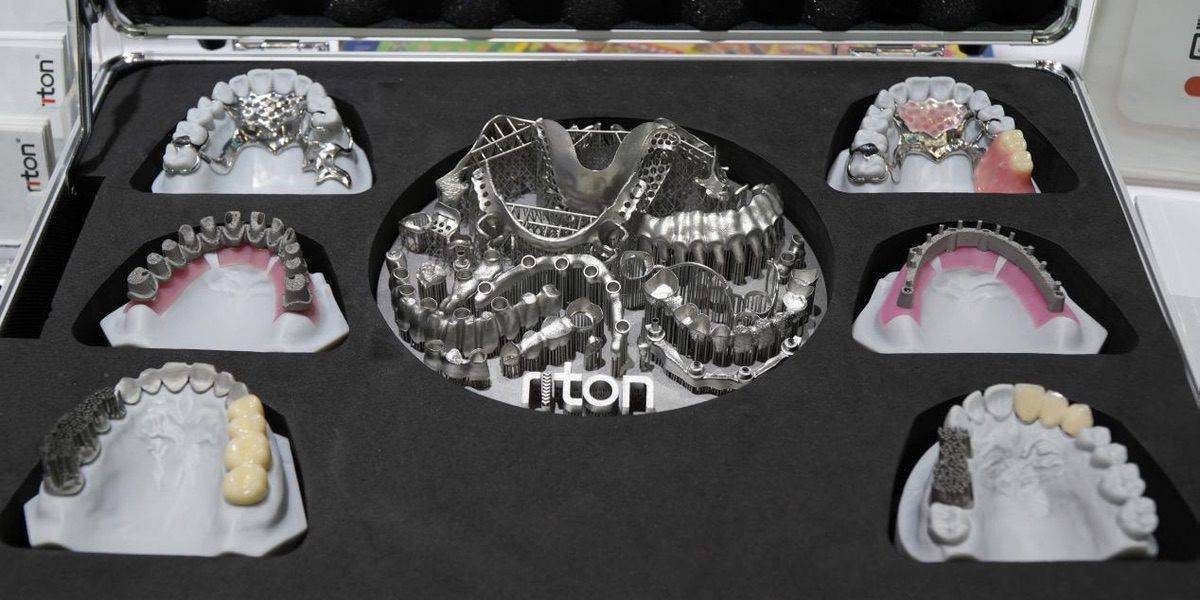
Guangzhou Ruitong showcases full-stack dental digital solution with MLAB desktop metal printer at Beijing exhibition

Hardware
Originally reported by 南极熊3D打印网
Guangzhou Ruitong Additive Manufacturing (Ruitong) unveiled its full-stack dental digital solution at the Beijing International Dental Exhibition on June 10, 2026, featuring the new desktop metal LPBF printer MLAB alongside its established M-150 production system. The MLAB is designed for chairside and lab environments, with a compact footprint enabling direct placement in dental technician workspaces. Ruitong also demonstrated its proprietary removable lingual bracket system, which uses 3D-printed snap-fit mechanisms to eliminate ligature wires, and two AI-vision-guided wire-bending machines for orthodontic archwires and clasps. The company positions itself as a "full-stack digital dental operator," covering metal printing, resin printing, and intelligent bending across production and chairside workflows.
This announcement fits the broader pattern of Chinese AM vendors localizing supply chains and integrating materials, software, and post-processing into turnkey vertical solutions. Ruitong is targeting the medical-dental segment, where Align Technology remains the largest production AM user globally via vat photopolymerization, but metal LPBF for crowns, bridges, and orthodontic brackets is a fast-growing subsegment. The MLAB directly competes with desktop metal LPBF systems from vendors like Eplus3D and Shining 3D in China, and internationally with systems from One Click Metal and Xact Metal. Ruitong's differentiation lies in bundling printing with proprietary materials, AI bending, and the lingual bracket design - a move that shifts value capture from hardware alone to a full digital workflow. The dental AM market in China is expanding as clinics seek same-day fabrication, and Ruitong's chairside resin printer and MLAB address the gap between centralized production labs and point-of-care manufacturing.
For dental labs and clinics evaluating metal AM adoption, Ruitong's integrated approach reduces the integration risk of sourcing printers, materials, and post-processing from separate vendors. The MLAB's compact size and the AI bending machines address two practical barriers: space constraints in small labs and the skilled-labor dependency of manual wire bending. The key execution challenge will be qualifying the MLAB's print consistency for medical-grade cobalt-chrome and Ti-6Al-4V parts across multiple lab environments, and building the service network to support chairside deployments where uptime is critical.
This article is an AI-assisted rewrite of the linked source report. Facts originate from the source; phrasing is AMPulse's. Use Read Original below to verify, or Report an issue if something is wrong.