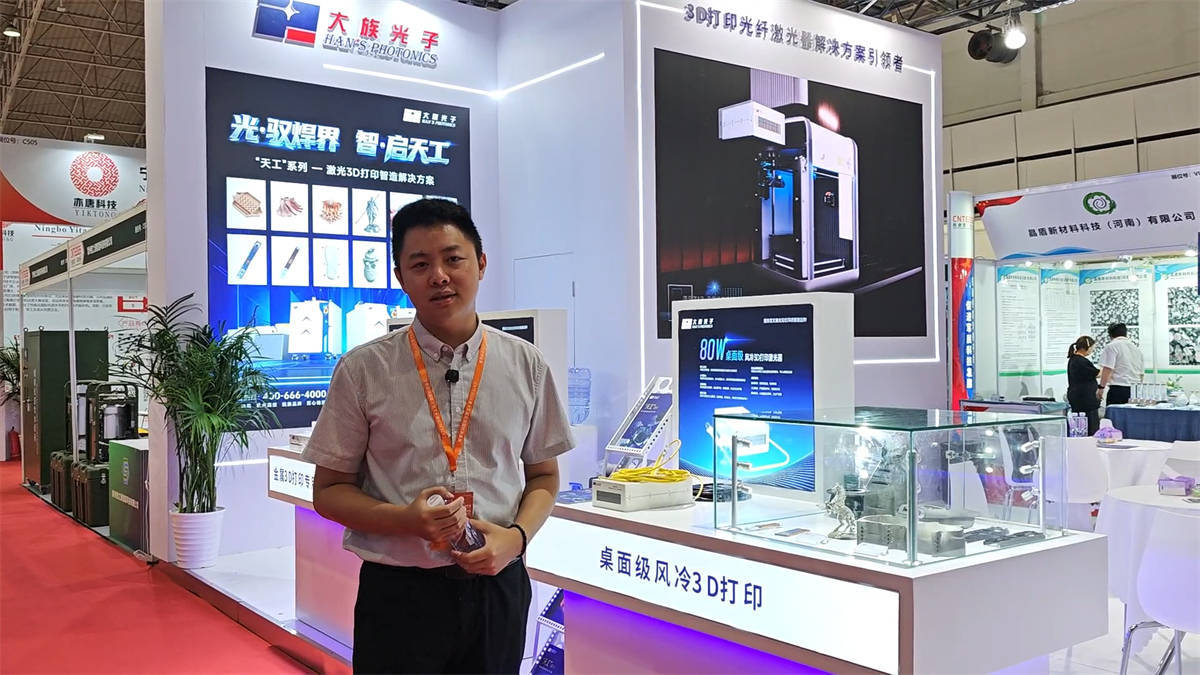
Han's Photonics launches full-series 3D printing laser lineup with miniaturized, green-light, and dual-beam breakthroughs

Hardware
Originally reported by 南极熊3D打印网
Han's Photonics, a subsidiary of Han's Laser Group and a leading Chinese fiber laser manufacturer, unveiled a comprehensive series of additive-manufacturing-specific lasers at the 13th China (Beijing) International 3D Printing Technology Exhibition on June 16-18, 2026. The lineup includes an 80W desktop-class miniaturized laser for consumer-grade metal and polymer printing, a 2μm thulium-doped fiber laser for polymer SLS, a 532nm green-light laser for pure copper and high-reflectivity metal printing, and a native ring-mode dual-beam laser with independently controllable center and outer beam power. According to He Jiaming, a company representative, the 80W laser is already in joint development with leading Chinese OEMs for both SLS and metal PBF-LB applications, while the 2μm laser has completed product qualification and is undergoing customer process validation. The green-light laser targets the copper printing bottleneck in thermal management and electronics, where copper absorbs only 5% of conventional 1080nm infrared light but 40% of 532nm green light, dramatically reducing reflectivity and spatter defects.
This launch represents a significant upstream move in the AM value chain, where laser source innovation directly dictates process capability and cost structure. The 80W miniaturized laser addresses a long-standing gap in the Chinese market: affordable, compact laser sources that can enable desktop metal and polymer AM systems for prototyping, education, and small-batch production. This aligns with the broader trend of consumer-electronics-grade AM adoption, where lower-cost, lower-power systems can serve niche applications without competing with industrial 500W-1000W platforms. The 2μm thulium laser tackles a known weakness in polymer SLS - poor absorption of standard 1080nm infrared by many engineering polymers - potentially improving surface finish and sintering uniformity for nylon and elastomer parts. The native dual-beam laser, which generates a ring-mode beam directly from the laser cavity rather than through external DOE optics, offers real-time beam shape modulation without switching delays, a feature that could reduce cracking in difficult-to-weld alloys and improve melt pool stability in metal PBF-LB. This positions Han's Photonics as a vertically integrated supplier capable of customizing laser wavelengths and beam profiles for specific materials and processes, a capability that Chinese AM OEMs increasingly demand as they compete on both cost and performance.
From a practical standpoint, Han's Photonics must now demonstrate that these lasers can achieve consistent, repeatable performance across production-scale machine fleets, not just in lab demonstrations. The 80W laser's success hinges on whether it can drive meaningful adoption in desktop metal and polymer systems, where cost sensitivity is extreme and reliability expectations are high. The green-light and dual-beam lasers face a steeper qualification path, as copper and refractory alloy printing are still niche applications with limited production volumes. The company's strategy of co-developing with downstream OEMs is sound, but the real test will be whether these lasers can be integrated into qualified production workflows that meet end-user quality and throughput requirements. For buyers, the immediate takeaway is that Chinese laser suppliers are now offering wavelength and beam-shaping options that were previously only available from Western photonics leaders like TRUMPF and nLIGHT, potentially lowering the cost of specialized AM processes.