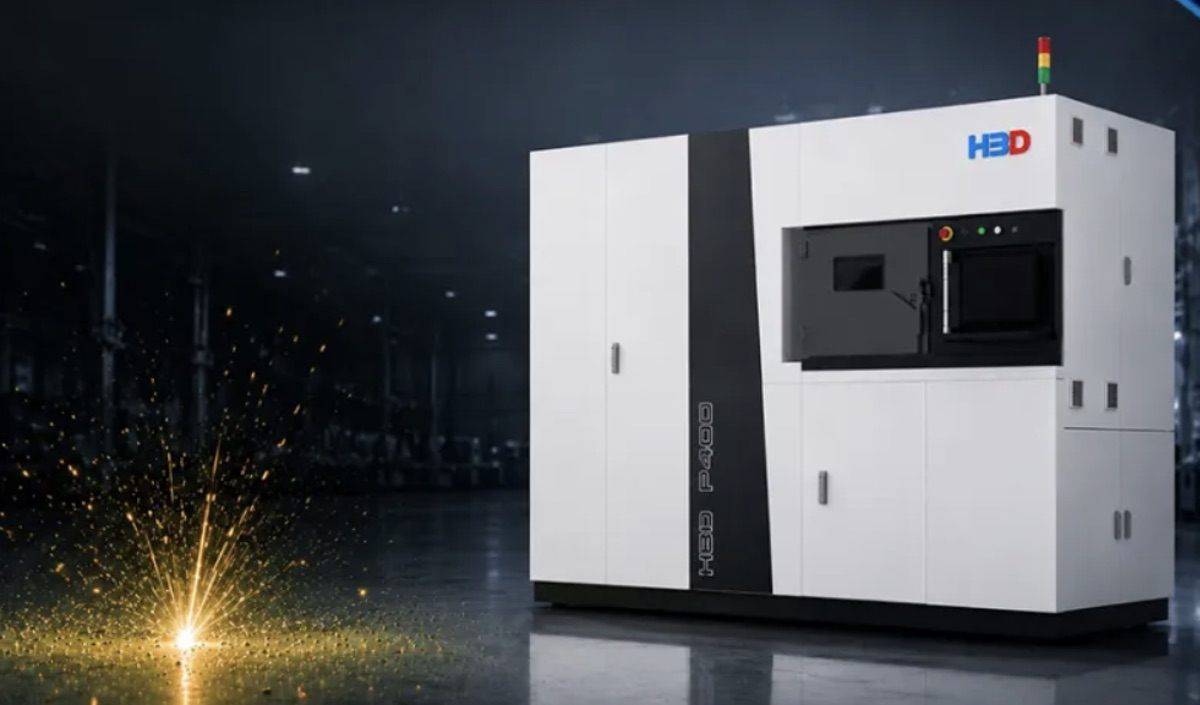
Hanbang Laser HBD P400 targets lightweighting and functional integration in robotics

Hardware
Originally reported by 南极熊3D打印网
Hanbang Laser, a Chinese metal additive manufacturing (AM) systems provider, has highlighted its HBD P400 LPBF system for producing lightweight, functionally integrated robot components. The company, in a June 18, 2026, article published via the 3D printing news outlet Nanjixiong, details how the HBD P400 enables the direct printing of complex geometries like internal cooling channels, lattice structures, and bionic topologies in a single build. The system, with a 350×400×400mm build volume, supports titanium alloys (Ti-6Al-4V), aluminum alloys, and stainless steel, and is positioned for the serial production of mid-to-large robot structural parts, including hip joints and leg support frames.
The HBD P400 is entering a metal PBF-LB market that is increasingly split between Western incumbents like EOS and Trumpf, and a growing cohort of capable Chinese OEMs. Hanbang Laser is not a new entrant; it has been a recognized player in the Chinese AM market for several years, and this announcement is less a product launch and more a targeted marketing push into the fast-growing robotics and embodied AI vertical. The company's claim of achieving up to 40% weight reduction on specific components (e.g., a 667g aluminum joint part) while maintaining structural integrity is a standard benefit of topology-optimized LPBF, not a unique differentiator. The real competitive question is whether Hanbang can deliver the process repeatability and material qualification data that robotics OEMs-who are increasingly moving from prototyping to production-will demand.
For buyers evaluating the HBD P400, the practical takeaway is that Hanbang is offering a credible, mid-format production machine at a price point likely well below comparable Western systems. The key execution risk is not the hardware itself, but the company's ability to build a robust service and support ecosystem for customers outside of China, and to provide the rigorous material and process validation data required for high-cycle, safety-critical robot joints. The company's focus on functional integration-combining motor mounts, bearing seats, and cooling channels into a single printed part-is a genuine value proposition that aligns with the broader industry trend toward part consolidation in AM, but it remains to be seen if this translates into a repeatable, cost-effective production workflow.
Topics