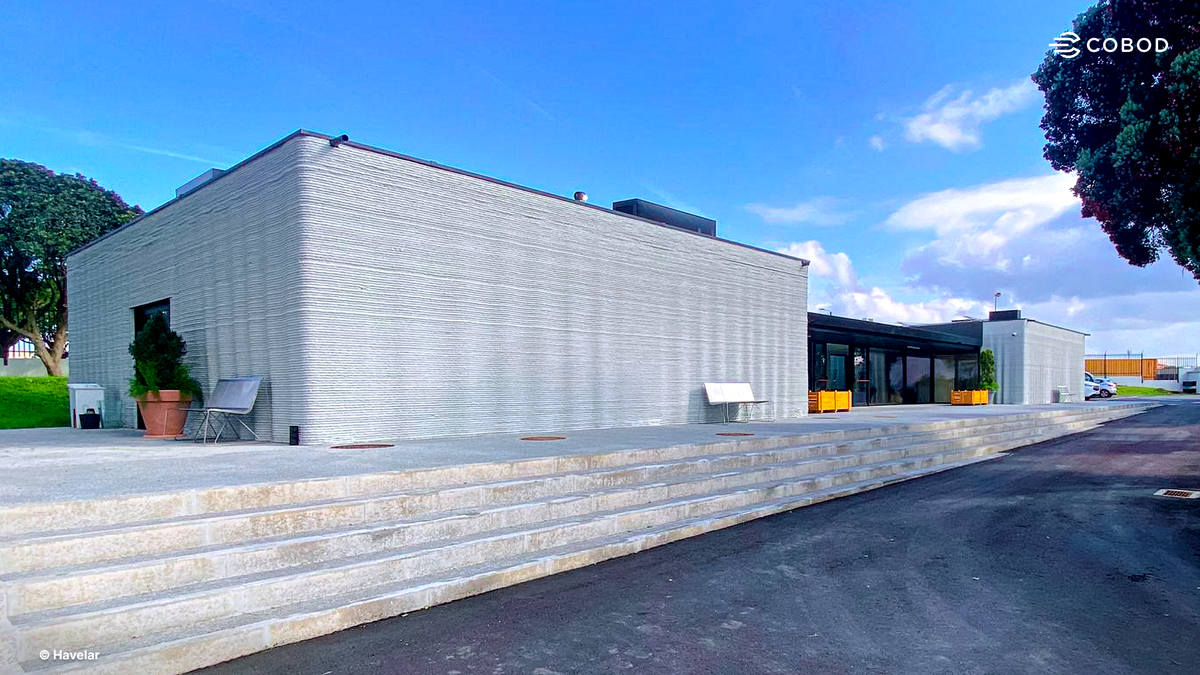
Havelar delivers 500 m² public building in Porto with COBOD BOD2, printed in nine days on budget

Hardware
Originally reported by TCT Magazine
Portuguese construction 3D printing firm Havelar has completed a 500 m² (5,400 ft²) recycling centre office at the Ecocentro de Perafita in Porto, using a COBOD BOD2 construction 3D printer. The structure was printed in nine days by a four-person crew and delivered on budget for the municipality of Matosinhos. The building features curved walls throughout, a design element that would incur significant cost with conventional formwork but is produced directly from the digital model at no additional labour or material expense. This project brings Havelar's portfolio of 3D-printed buildings in Porto to 32, with more than 50 additional structures scheduled for 2026.
This project matters because it demonstrates that construction 3D printing can deliver public infrastructure on conventional procurement terms - on budget, on schedule, and with a radically smaller workforce. The four-person crew versus a typical construction team of 12–15 people is not a laboratory curiosity; it is a real labour-cost advantage that scales directly with project count. Havelar's 32-building track record in a single metro area, with 50 more planned, suggests the technology has moved past the demonstration phase into repeatable production for a municipal client. For COBOD, this is a reference case that strengthens its positioning against competitors such as ICON and Peri 3D Construction, particularly in European public-sector markets where budget certainty and labour shortages are persistent pain points. The curved-wall capability also addresses a common criticism of construction 3D printing - that it produces boxy, monotonous forms - by showing that architectural differentiation comes at zero incremental cost.
Practically, the key question is whether Havelar can sustain this cadence across the 50-plus projects planned for 2026 without quality degradation or schedule slippage. The four-person crew claim is impressive but depends on the BOD2's reliability and the availability of trained operators. For municipal buyers evaluating construction 3D printing, this project provides a credible data point on cost and timeline, but they should ask whether the per-square-metre cost holds when the building geometry becomes more complex or when interior finishing and MEP integration are factored into the total project budget.
Topics