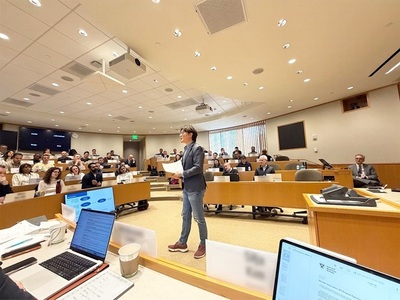
Brism Co-CEO Presents Custom Eyewear Strategy at Harvard Business School OPM Program
Originally reported by newspim.com
Brism co-CEO Park Hyung-jin presented the company's custom eyewear business strategy at Harvard Business School's Owner/President Management (OPM) program on May 4, 2026. The session was part of Professor Juan Alcacer's 'Strategy to Win' class, based on the HBS case study 'Breezm: Innovative 3D Printed Eyewear (A).' Park discussed Brism's use of facial-scanning data, mobile app-based virtual try-on, and 3D printing for personalized frame production. Co-CEO Sung Woo-seok and US business development director Kim Si-hyun also attended the lecture, which included discussion on product-market fit and global expansion strategy.
This event places Brism within the polymer vat photopolymerization (VPP) segment of additive manufacturing, specifically targeting the consumer goods vertical through mass customization. The company's model mirrors the approach of Align Technology in dental aligners - using digital scanning, proprietary software, and 3D printing to create individualized products at scale. However, Brism operates in a smaller, more fragmented market: custom eyewear, where the addressable market is estimated at several billion dollars globally but faces competition from traditional optical chains and online retailers using conventional manufacturing. The HBS case study recognition signals that Brism's business model has achieved sufficient differentiation and traction to warrant academic analysis, though the company has not disclosed production volumes or revenue figures.
For Brism, the practical next step is converting this academic validation into measurable commercial outcomes - specifically, demonstrating repeatable unit economics across multiple geographies. The company must prove that its digital-to-physical workflow can scale beyond the Korean domestic market while maintaining the customization quality that justifies a premium price point. Investors and potential partners should look for disclosed production capacity, average order values, and customer acquisition costs rather than academic endorsements as indicators of sustainable growth.
Topics