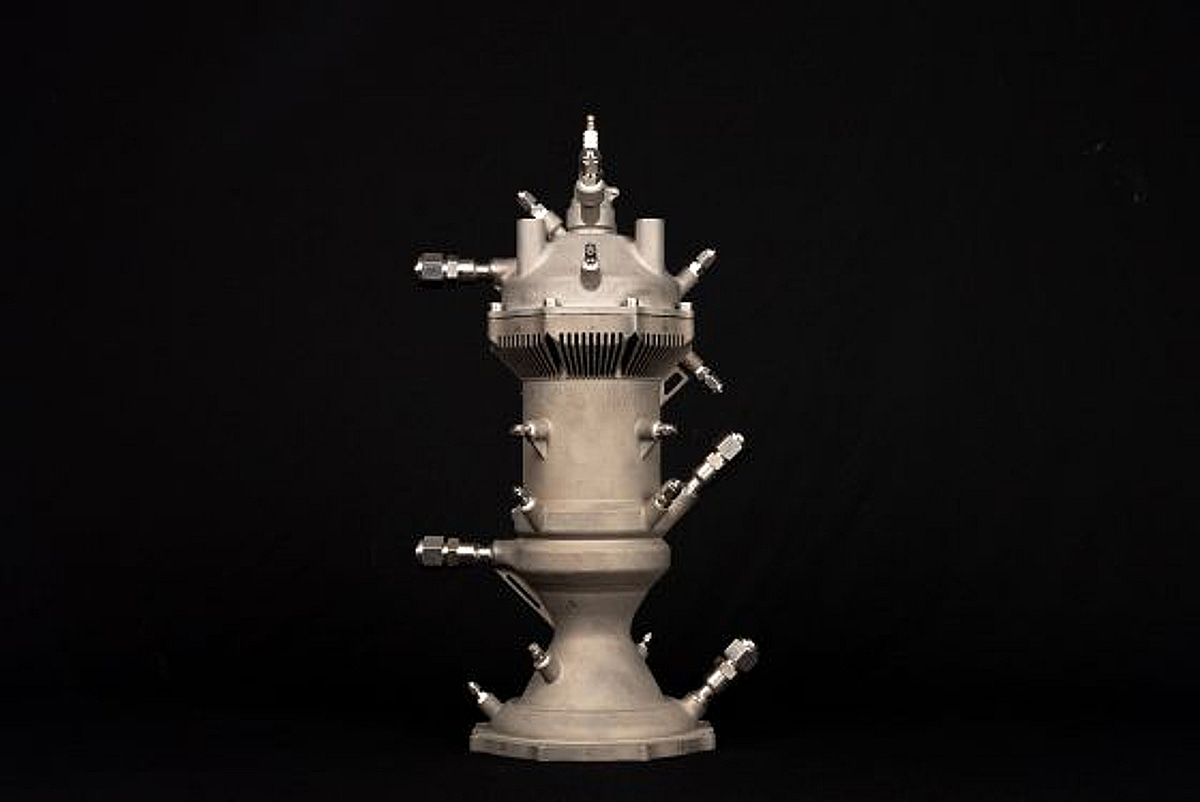
Innospace completes 420-second methane engine test for Hanbit-Micro kickstage, leverages AM for dual-propellant regenerative cooling

Application
Originally reported by mt.co.kr
South Korean launch startup Innospace announced on June 4, 2026, that it has completed development of the dual-propellant regenerative cooling methane engine (LiMEK-04) for its Hanbit-Micro small-satellite launch vehicle. The engine, producing 0.4 tons of thrust, was successfully ground-tested for 420 seconds - the longest such test in South Korea. The combustion chamber and mixer were produced using metal additive manufacturing (LPBF) at the company's Hwaseong campus, enabling the complex internal channels required for the cooling architecture.
The dual-propellant design uses both liquid methane and liquid oxygen as coolants, increasing coolant flow 3.0–3.4 times over conventional single-propellant systems. This allows stable cooling at lower supply pressure, enabling lighter tank and feed-system designs - a critical advantage for weight-sensitive small launch vehicles. The milestone fits a recurring pattern in the AM industry: aerospace companies leveraging additive manufacturing to achieve geometries that are impossible with conventional machining, then using that capability to improve system-level performance. Innospace is now one of a handful of private firms worldwide to demonstrate a regeneratively cooled methane engine built with AM components.
The 420-second test validates the engine's durability and thermal management, but flight qualification remains the next hurdle. Innospace must translate this single-test demonstration into repeatable production of AM engine parts, with consistent material properties and defect-free builds. The company also needs to secure a reliable supply chain for high-temperature alloys and establish in-house quality protocols that meet launch-vehicle standards. For the broader AM industry, this case reinforces that metal additive manufacturing is becoming a standard tool in advanced propulsion engineering, particularly for small launchers and kickstage applications where mass and performance margins are narrow.
This article is an AI-assisted rewrite of the linked source report. Facts originate from the source; phrasing is AMPulse's. Use Read Original below to verify, or Report an issue if something is wrong.
Topics