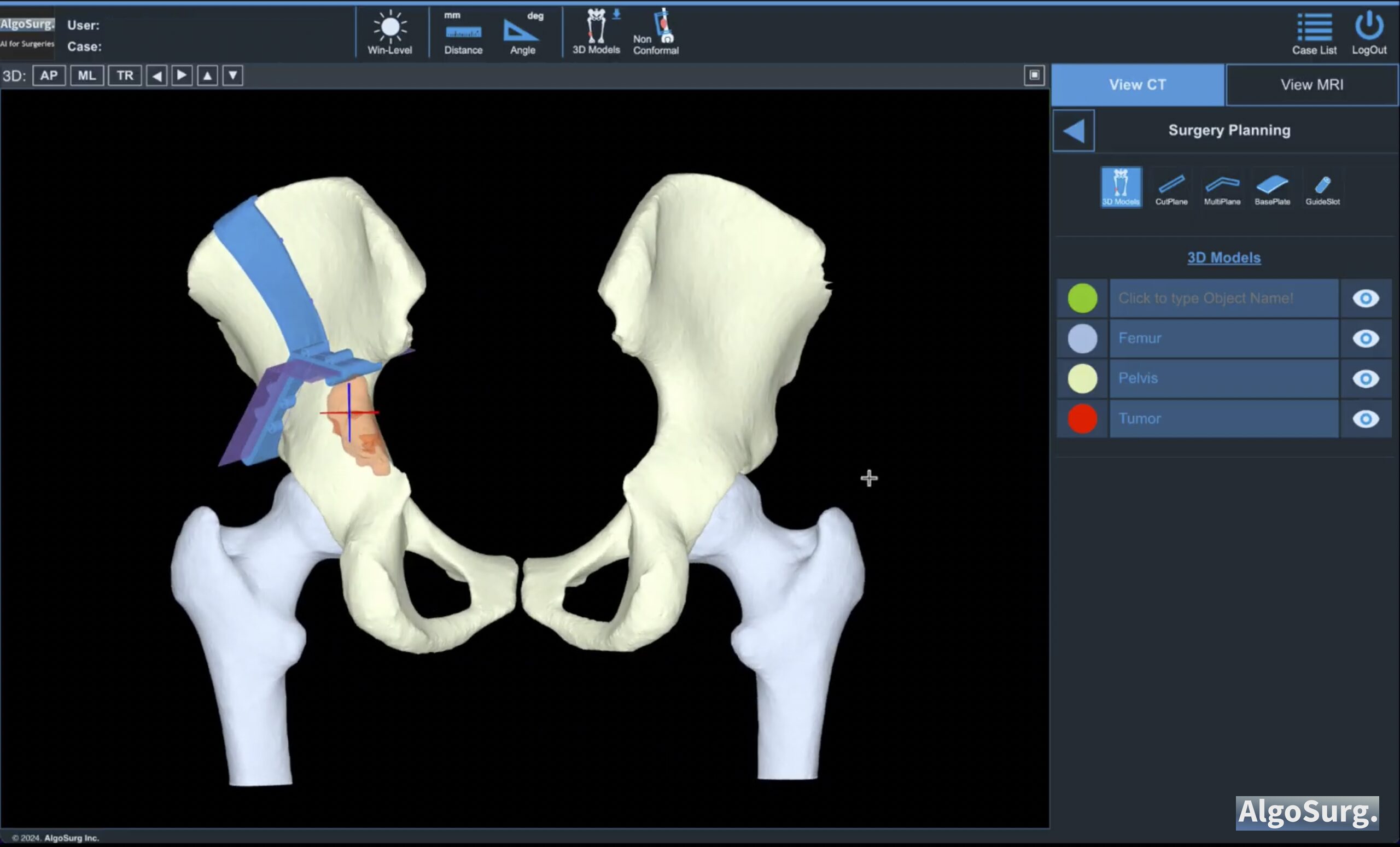
AlgoSurg CEO Vikas Karade outlines AI-driven automation strategy for medical 3D printing data workflows

Software
Originally reported by 3Druck
AlgoSurg Inc., a developer of AI-powered software for surgical planning and medical imaging, is targeting the bottleneck that limits wider clinical adoption of patient-specific 3D printed implants and surgical guides. In an interview with 3Druck.com, founder and CEO Dr. Vikas Karade detailed how the company automates the conversion of CT and MRI data into segmented anatomical 3D models, which then feed into the design of patient-matched instruments and implants. The company operates at the digital pre-production layer of the medical 3D printing value chain, focusing on segmentation, planning, and CAD preparation rather than operating its own printing service or selling printers. AlgoSurg's approach leverages neural networks for segmentation, cloud-based workflows, and automated planning functions for applications in maxillofacial surgery, orthopedic tumor resection, and complex deformity correction.
This strategy addresses a structural gap in the medical AM market. While laser powder bed fusion (LPBF) and vat photopolymerization (VPP) systems for producing surgical guides and titanium implants are widely available, and materials such as Ti-6Al-4V are qualified, the manual labor required for data segmentation and case-specific design remains the primary cost and time barrier. AlgoSurg directly tackles this data-to-design bottleneck. Its position in the value chain places it as a software enabler connecting hospitals and clinicians to downstream manufacturing partners - a role that captures value through workflow efficiency rather than hardware margins. The company’s emphasis on validation and reproducibility of data processes aligns with the qualification requirements that govern medical device production under FDA 510(k) and CE-MDR regulatory pathways, particularly as the industry moves toward more scalable, production-grade medical AM.
For hospitals and clinical labs evaluating point-of-care 3D printing, AlgoSurg’s value proposition rests on whether its automated segmentation and planning tools can consistently reduce case turnaround time below what manual technicians achieve with standard DICOM-to-STL pipelines. The key execution challenge is not accuracy alone, but integration into existing hospital PACS systems and surgical planning workflows. Karade’s framing - that AI should support, not replace, surgeon decision-making in the planning phase - is the correct one for adoption in a risk-averse medical environment. The company’s near-term success will be measured by the number of surgical cases routed through its platform, not by patent counts or demo videos.
This article is an AI-assisted rewrite of the linked source report. Facts originate from the source; phrasing is AMPulse's. Use Read Original below to verify, or Report an issue if something is wrong.
Topics