KIST Develops 3D-Printable Ultra-Thin Film Blocking 99.999% of Electromagnetic Waves and 72% of Neutrons

Materials
Originally reported by v.daum.net
KIST Develops 3D-Printable Ultra-Thin Film Blocking 99.999% of Electromagnetic Waves and 72% of Neutrons
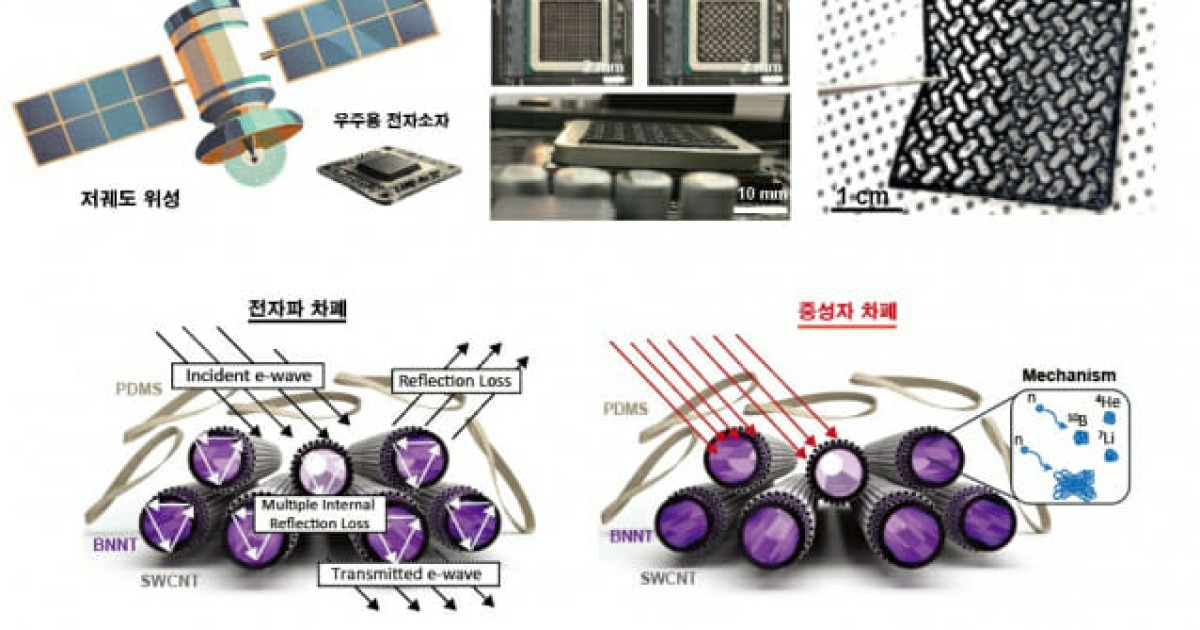
Researchers at the Korea Institute of Science and Technology (KIST) in Seoul, led by Principal Researcher Joo Yong-ho, have developed a 3D-printable ultra-thin composite film capable of simultaneous electromagnetic interference (EMI) and neutron shielding. The material utilizes a shell-like structure combining Carbon Nanotubes (CNT) for electromagnetic absorption and Boron Nitride Nanotubes (BNNT) for neutron capture. Testing confirms the film achieves 99.999% EMI shielding and 72% neutron reduction at thicknesses thinner than a human hair, while maintaining performance when stretched to twice its original length. The composite remains stable across a temperature range from -196 to 250 degrees Celsius.
This development addresses a critical weight and complexity gap in the aerospace, nuclear, and medical device sectors, where traditional shielding materials are often heavy, rigid, or require multi-layered assembly. By enabling the 3D printing of complex geometries like honeycomb structures, KIST has demonstrated a 15% increase in shielding efficiency compared to flat films. This capability allows for the integration of multifunctional protection directly into lightweight components for satellites, space stations, and wearable radiation protection. The ability to print these materials via additive manufacturing processes provides a significant advantage over traditional subtractive or casting methods for high-performance, specialized shielding applications.
Practical implementation will require the development of scalable extrusion-based 3D printing hardware capable of handling high-viscosity nanotube-loaded resins or filaments without compromising the CNT/BNNT shell structure. For aerospace and nuclear end-users, the immediate value lies in the reduction of part counts through the consolidation of structural and shielding functions into a single printed component. Future validation must focus on long-term radiation aging and the consistency of nanotube dispersion during high-speed additive manufacturing cycles.
This article is an AI-assisted rewrite of the linked source report. Facts originate from the source; phrasing is AMPulse's. Use Read Original below to verify, or Report an issue if something is wrong.
Topics