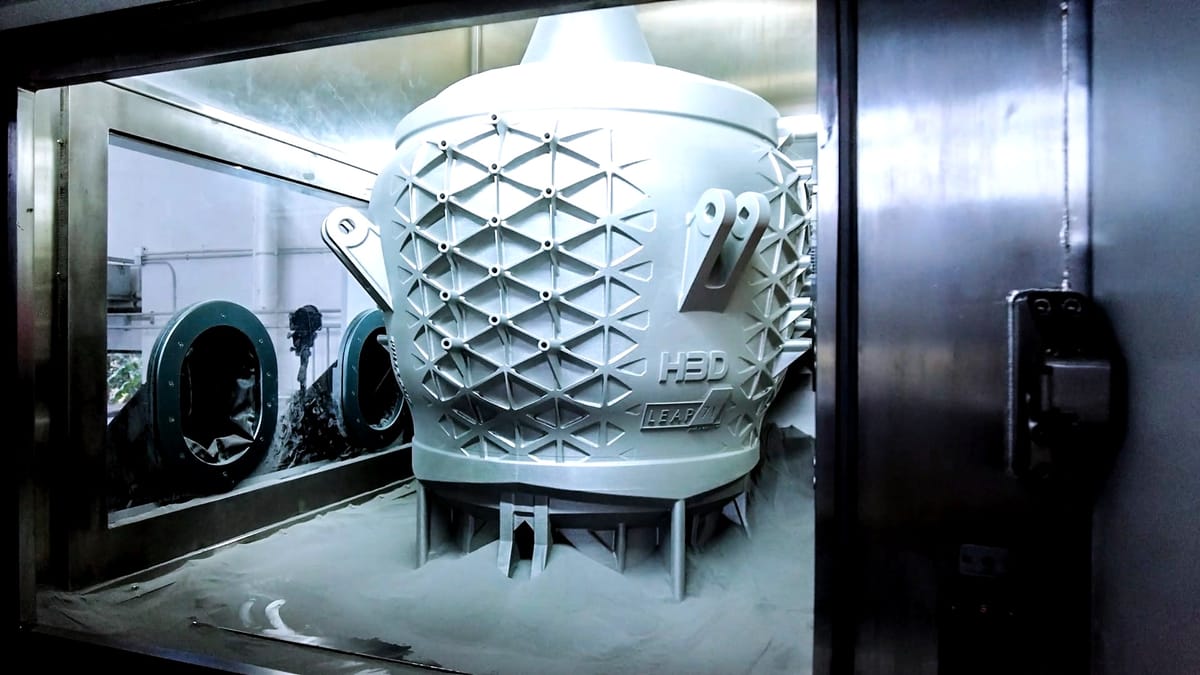
LEAP 71 and HBD have successfully additively manufactured the XRA-2E5, a 200kN thrust aerospike rocket engine, utilizing the HBD 800 large-format laser powder bed fusion system.

Software
Originally reported by TCT Magazine
LEAP 71 and HBD have successfully additively manufactured the XRA-2E5, a 200kN thrust aerospike rocket engine, utilizing the HBD 800 large-format laser powder bed fusion system. The one-meter tall component was printed as a monolithic structure using Inconel 718, a high-temperature nickel superalloy, and designed autonomously via LEAP 71's Noyron computational engineering model. This project, conducted in collaboration with Aspire Space, represents a significant scale-up from the company's previous 20kN methalox engine tests conducted over the last 15 months. The engine features an integrated regenerative cooling system, utilizing methane for the outer chamber and liquid oxygen for the central spike.
This development addresses the long-standing geometric complexity of aerospike nozzles, which have historically been difficult to manufacture using traditional subtractive methods. While conventional bell-shaped nozzles are optimized for specific altitudes, the aerospike architecture offers high efficiency across varying atmospheric pressures, providing a distinct advantage for fully reusable launch vehicles. By integrating physics-driven software with large-format LPBF hardware, LEAP 71 is bypassing traditional design-for-manufacturing bottlenecks that have kept aerospikes in the theoretical domain for decades. This milestone highlights the increasing capability of industrial AM to produce complex, flight-ready propulsion hardware at scale, positioning the company as a key software-driven player in the aerospace value chain.
This achievement signals a shift toward autonomous, physics-based design cycles that reduce the time between conceptualization and physical hardware validation. The ability to print such large, complex geometries in a single build suggests that production economics for high-performance rocket components will continue to improve as large-format metal AM systems become more reliable. Industry observers should monitor the upcoming hot-fire qualification tests, as successful performance would validate the viability of Noyron-generated designs for commercial orbital launch applications.
Topics