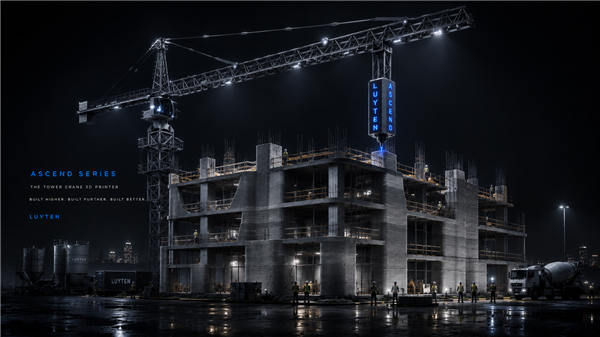
Luyten launches world's first robotic tower crane 3D printer 'Ascend' capable of building 100-meter concrete structures

Hardware
Originally reported by tech.sina.cn
Australian robotics and 3D printing company Luyten has unveiled the Ascend, a robotic tower crane platform designed for large-scale concrete additive manufacturing. The system integrates a tower crane structure, robotic manipulation, AI-driven path planning, and Luyten's proprietary Ultimatecrete printable concrete material to erect structures up to 100 meters tall with a working radius of 45 meters. According to the company, the Ascend can be installed and commissioned within one to two days, significantly reducing deployment timelines for high-rise residential, multi-story commercial, and infrastructure projects. Luyten CEO Ahmed Mahil stated that the platform transforms the tower crane - a staple of construction sites - into a robotic fabrication system that builds directly from digital models, bypassing traditional formwork and reducing manual labor requirements.
This launch extends concrete 3D printing beyond the single-story, gantry-based systems that have dominated the segment since COBOD, ICON, and Peri pioneered the field. While those platforms have demonstrated viability for low-rise housing and architectural elements, the vertical reach and payload capacity of a tower crane configuration address a structural gap: the inability to print multi-story load-bearing walls without intermediate crane lifts or manual reinforcement. Luyten's approach effectively merges the construction industry's most ubiquitous lifting machine with additive deposition, creating a hybrid that could accelerate adoption in regions facing acute labor shortages and housing demand, particularly in Australia and parts of Asia. The integration of AI for print-path optimization and real-time monitoring also moves concrete AM closer to the digital-workflow maturity seen in metal PBF-LB and polymer MJF, though the construction vertical remains far behind those segments in qualification standards and repeatability.
For Luyten, the Ascend represents a bet on vertical integration - hardware, material, and software - in a market where most concrete AM competitors license third-party materials or rely on generic gantry platforms. The company must now demonstrate that the system can achieve consistent interlayer adhesion and structural certification at full height, a qualification burden that has slowed every concrete AM entrant to date. Buyers evaluating the Ascend should weigh its claimed speed and reach against the real-world cost of material qualification, site-specific engineering, and local building-code acceptance, which remain the binding constraints for high-rise concrete AM regardless of the printer architecture.
Topics