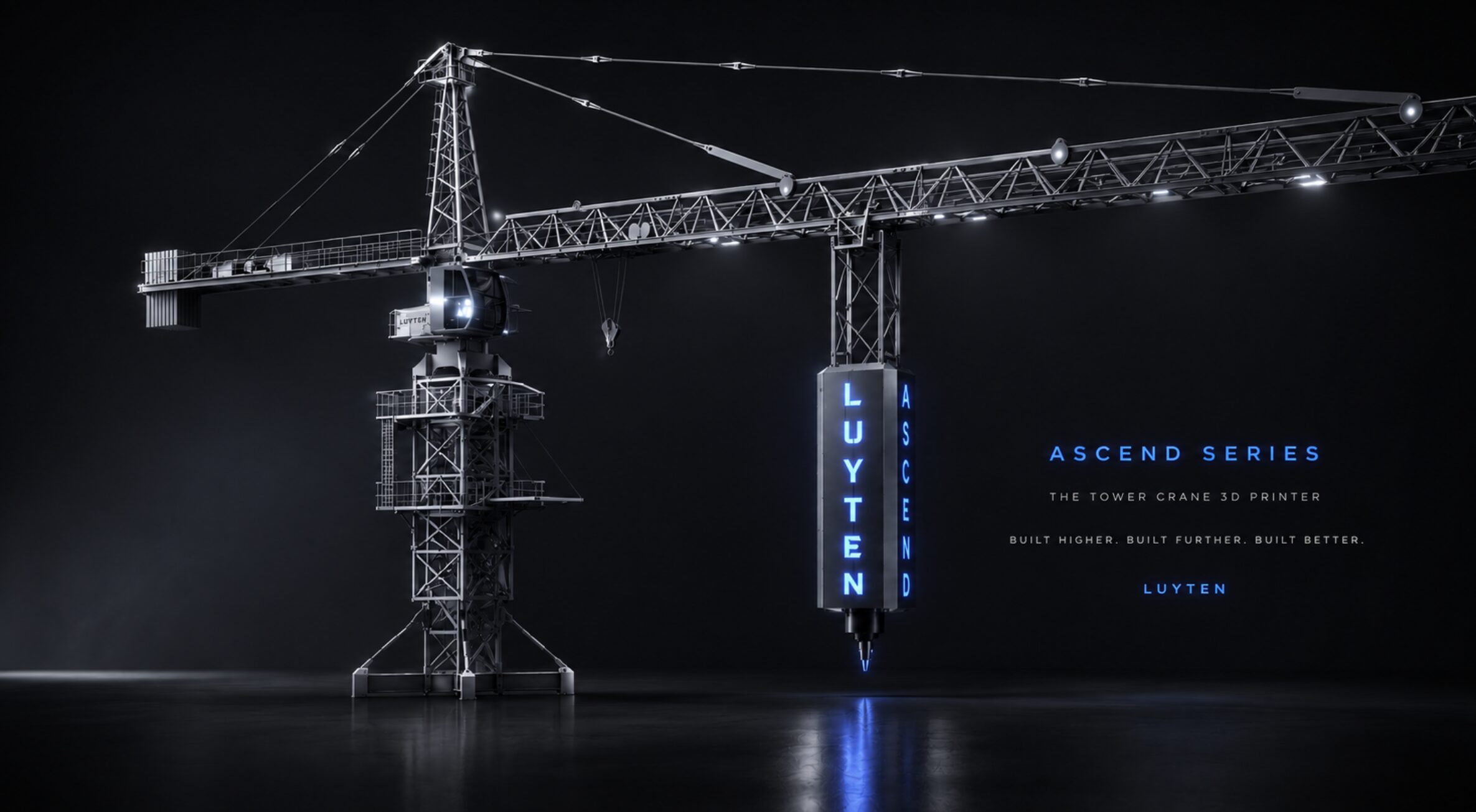
LUYTEN opens reservations for crane-based concrete 3D printing platform ASCEND A27

Hardware
Originally reported by 3Druck
Australian construction technology company LUYTEN has opened early reservations for its ASCEND A27 automated building platform, a crane-mounted concrete 3D printing system targeting multi-story construction projects. Reservations are open until October 25, 2026, with a deposit credited toward the final purchase price. Rather than using a standalone gantry, the ASCEND A27 attaches robotic motion control, sensors, and an extrusion unit to existing tower cranes, enabling layer-by-layer deposition of cementitious materials guided by CAD data and AI-driven process control. The system includes real-time environmental monitoring for temperature, wind, and humidity, with adaptive parameter adjustment during printing. The platform builds on LUYTEN's Platypus printer series, including the Platypus X12 used to test large-format printing and autonomous control under demanding conditions, and incorporates experience from a fully 3D-printed multi-story house in Australia and other international projects.
This launch represents a pragmatic evolution in construction-scale AM, addressing a persistent barrier to adoption: the capital cost and site disruption of dedicated large-format gantry systems. By leveraging existing crane infrastructure, LUYTEN reduces the upfront investment and logistical complexity for contractors, potentially accelerating the commercial viability of on-site concrete printing for vertical construction. The construction AM segment remains fragmented, with competitors like COBOD, ICON, and Peri focusing on gantry-based or robotic-arm systems, but none have yet achieved widespread production deployment. LUYTEN's approach fits the pattern of adapting AM to existing industrial workflows rather than requiring dedicated factory floors, a strategy that has proven effective in metal AM through DED systems that integrate with robotic arms. The key question is whether the crane-mounted approach can deliver the positional accuracy and repeatability required for structural-grade concrete printing, especially under variable site conditions.
For LUYTEN, the ASCEND A27's commercial success will depend on execution in three areas: proving print quality and structural consistency across multiple projects, managing the coordination between crane movements and extrusion timing in continuous operation, and building a service network that can support construction crews unfamiliar with robotic AM. The early-reservation phase is a low-risk signal of market interest, but the real test will come when the first units are deployed on active construction sites and must meet building code requirements for load-bearing walls. Buyers should expect a learning curve around material formulation, site logistics, and integration with conventional reinforcement methods before the system can deliver repeatable, code-compliant results.