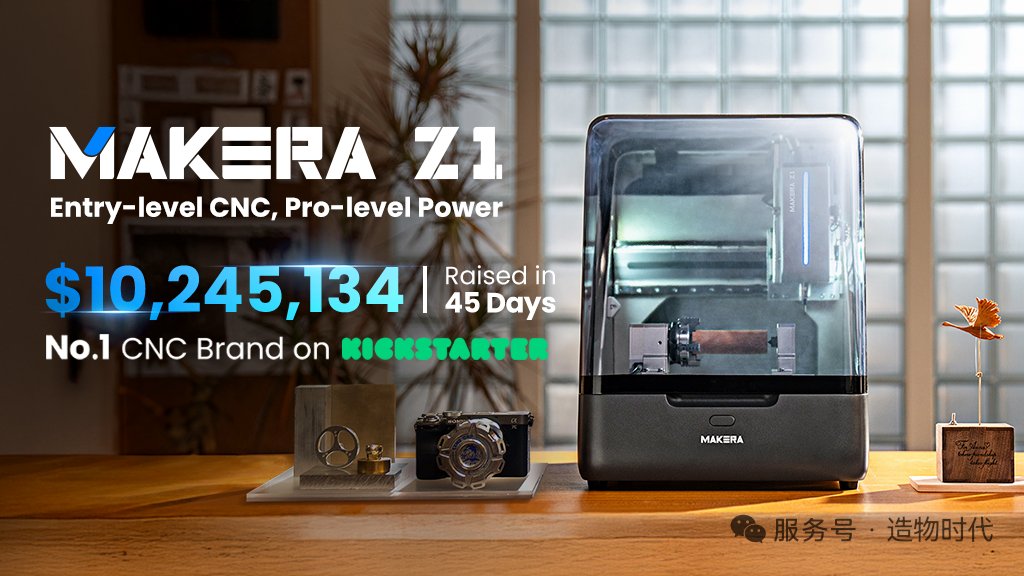
Makera raises hundreds of millions of yuan in Series A for consumer CNC and 3D printing

Hardware
Originally reported by tech.sina.cn
Makera (造物时代), a Shenzhen-based startup focused on desktop manufacturing, has closed a Series A funding round worth hundreds of millions of yuan (approximately $30–50M USD), the largest single investment ever in the consumer CNC category. The round was co-led by Huaying Capital and the Beijing Artificial Intelligence Industry Investment Fund, with participation from Yuanhe Puhua, Zhongke Chuangxing, Qingke Venture Capital, and existing investor Qiming Venture Partners. The company gained global attention in Q4 2025 when its Z1 desktop CNC machine raised $10.25M on Kickstarter from nearly 8,000 backers, setting a category record. Makera combines industrial-grade CNC control, automatic tool-changing, and dust/sound management into a compact form factor aimed at makers, designers, and DIY enthusiasts who want to cut metal and other materials with precision at home.
This funding signals that the consumer desktop manufacturing segment is expanding beyond polymer 3D printing into subtractive and multi-material workflows. Makera competes indirectly with desktop CNC players like Carbide 3D, Bantam Tools, and Snapmaker (which offers hybrid 3D printing/CNC/laser), but its Z1’s Kickstarter performance and the scale of this round suggest it is targeting a higher-end, more capable niche. The company has also developed its own CAM software with dozens of pre-optimized toolpath algorithms, lowering the barrier for users who lack traditional machining expertise. In the broader context of the desktop AM and digital fabrication market, Makera’s move mirrors the pattern of Chinese hardware startups localizing a Western-pioneered category (desktop CNC), integrating software and community, and then scaling aggressively on global crowdfunding and e-commerce channels.
Makera’s immediate challenge is converting Kickstarter backers into repeat customers and scaling production without the quality or delivery issues that have plagued other crowdfunded hardware startups. The company’s long-term value will depend on whether its software ecosystem and community platform create enough lock-in to sustain hardware margins. For buyers, the Z1 represents a genuine step forward in accessible metal machining, but they should evaluate it against their actual need for subtractive vs. additive capability rather than treating it as a universal desktop factory.
Topics