RYSE 3D scales polymer serial production to 4 million parts per year, exports to 23 hypercar projects

Service
Originally reported by 3D ADEPT
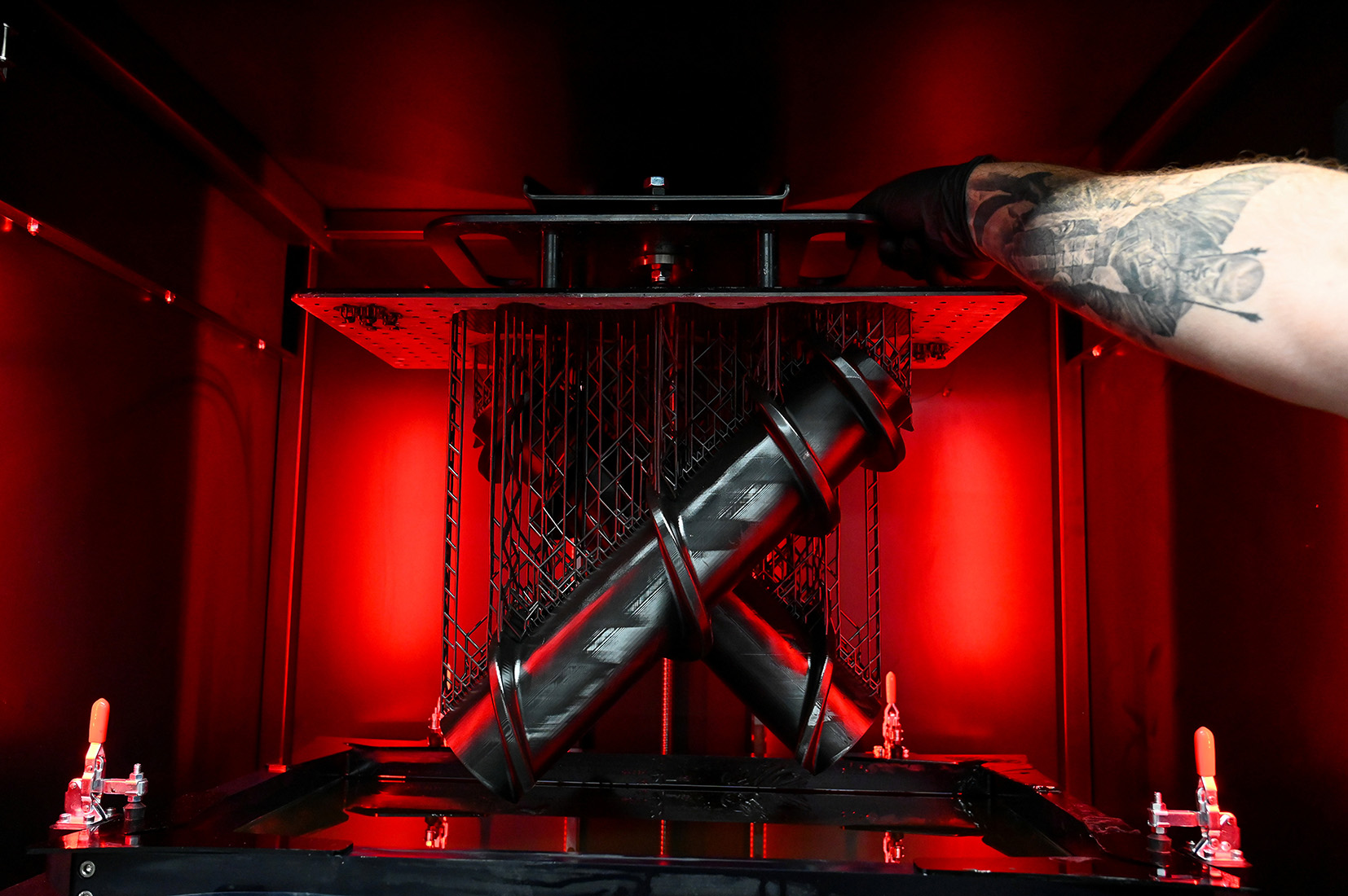
RYSE 3D, a UK-based additive manufacturing SME founded in 2017 by CEO Mitchell Barnes and his brother Cameron, has scaled its polymer serial production to four million components per year from its facility in Shipston-on-Stour. The company supplies high-performance polymer parts to 23 hypercar projects globally, alongside programs in aerospace, defense, and energy. Exports now account for nearly half of its revenue, reaching clients in the US, Denmark, France, and Latvia. RYSE 3D builds its production process around large-format polymer 3D printing using widely available engineering-grade materials, with no tooling investment required, and trains team members internally from non-technical backgrounds.
This scale-up is significant because it demonstrates that polymer AM can achieve serial production volumes typically associated with injection molding, but without the upfront tooling cost or lead time. RYSE 3D occupies the production service bureau segment of the value chain, competing with firms like Protolabs, Xometry, and HP’s Multi Jet Fusion network, but differentiates through its focus on large-format parts and high-performance engineering materials. The company’s ability to serve 23 hypercar projects - a demanding vertical requiring tight tolerances, material certification, and supply reliability - suggests it has solved the qualification and repeatability challenges that have historically limited polymer AM to prototyping and low-volume bridge production. The 50% export share also indicates that RYSE 3D is competing effectively beyond the UK market, leveraging its Midlands manufacturing base for cost-competitive European and US delivery.
From an expert perspective, RYSE 3D’s achievement is a concrete data point that polymer AM can reach injection-molding-like volumes in specific niches, but the company must now prove it can maintain quality and delivery consistency as it scales further. The hypercar and defense verticals are high-margin but low-volume relative to automotive or consumer goods, so the next test will be whether RYSE 3D can replicate this production discipline in higher-volume, lower-margin applications. For buyers evaluating polymer AM for serial production, RYSE 3D’s track record with 23 hypercar programs provides a reference case worth examining for material properties, lead times, and cost-per-part at scale.
Topics