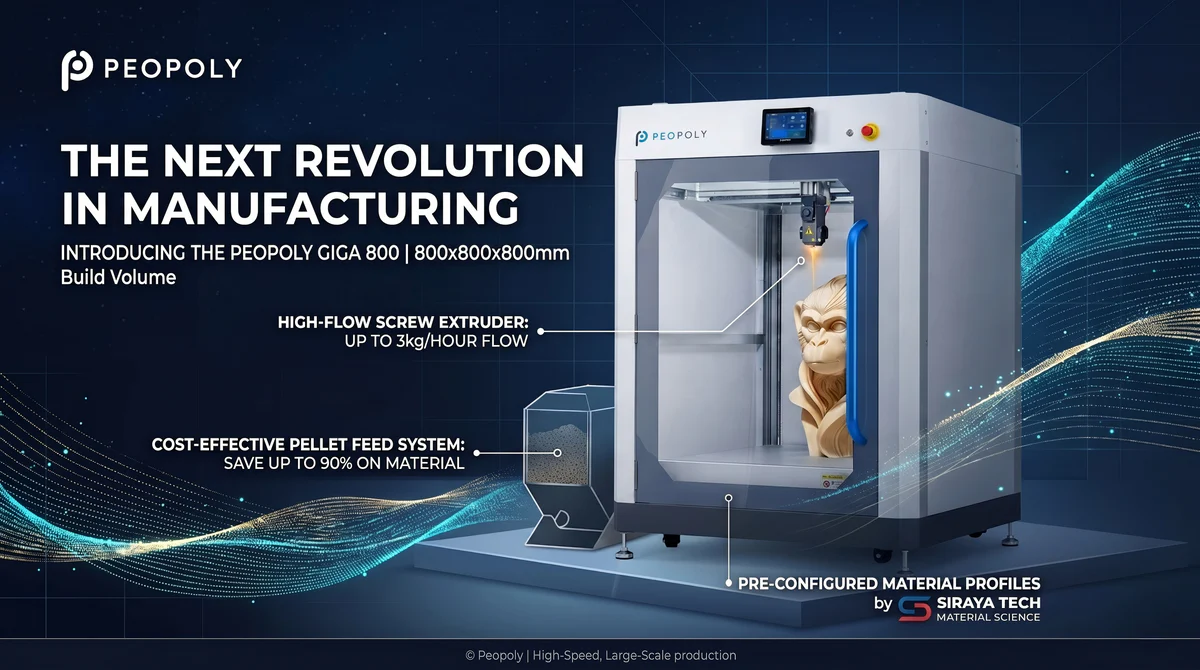
Peopoly Launches GIGA 800 Pellet 3D Printer for Industrial Tooling at $15,000

Hardware
Originally reported by 3D Printing Industry
Peopoly has introduced the GIGA 800 FGF Printer, a large-format pellet-extrusion system priced at $15,000 USD (EXW) with an 800 x 800 x 800 mm build volume. The machine uses a dual-zone heating screw extruder capable of 3 kg/hour flow rates and 400°C nozzle temperatures, supporting materials including ABS, PA-CF, PPA-CF, TPU, and PEBA elastomers. It runs on open-source Klipper firmware with pre-configured Orca Slicer profiles developed with Siraya Tech, and features a CoreXY motion system with closed-loop servo motors, a 60°C passively insulated enclosure, and a 120°C heated bed. Peopoly positions the system for industrial tooling, composite mold making, automotive fixtures, and architectural applications, emphasizing pellet feedstock's up to 90% material cost reduction versus spooled filament.
This launch targets the gap between desktop filament printers and industrial pellet systems that often cost $50,000–$150,000. Peopoly's $15,000 price point undercuts competitors like CEAD's Flexbot or Caracol's LFAM systems while offering comparable build volume and material breadth. The GIGA 800's integrated moisture-sealed hopper and support for fiber-reinforced engineering grades address real production pain points in tooling and jig manufacturing, where material consistency and part strength are critical. However, pellet extrusion remains a niche within polymer AM, dominated by service bureaus and in-house tooling shops rather than serial production. Peopoly's challenge is proving that a sub-$20K system can deliver the reliability and repeatability that industrial users expect from higher-priced alternatives.
For buyers evaluating large-format AM, the GIGA 800 offers a legitimate entry point into pellet-based tooling at a fraction of traditional costs. The real test will be whether Peopoly can support users with material profiles, spare parts, and service infrastructure beyond its existing desktop printer customer base. If the machine delivers on its flow rate and material claims, it could expand the addressable market for pellet extrusion beyond early adopters into cost-sensitive industrial tooling departments.
Topics