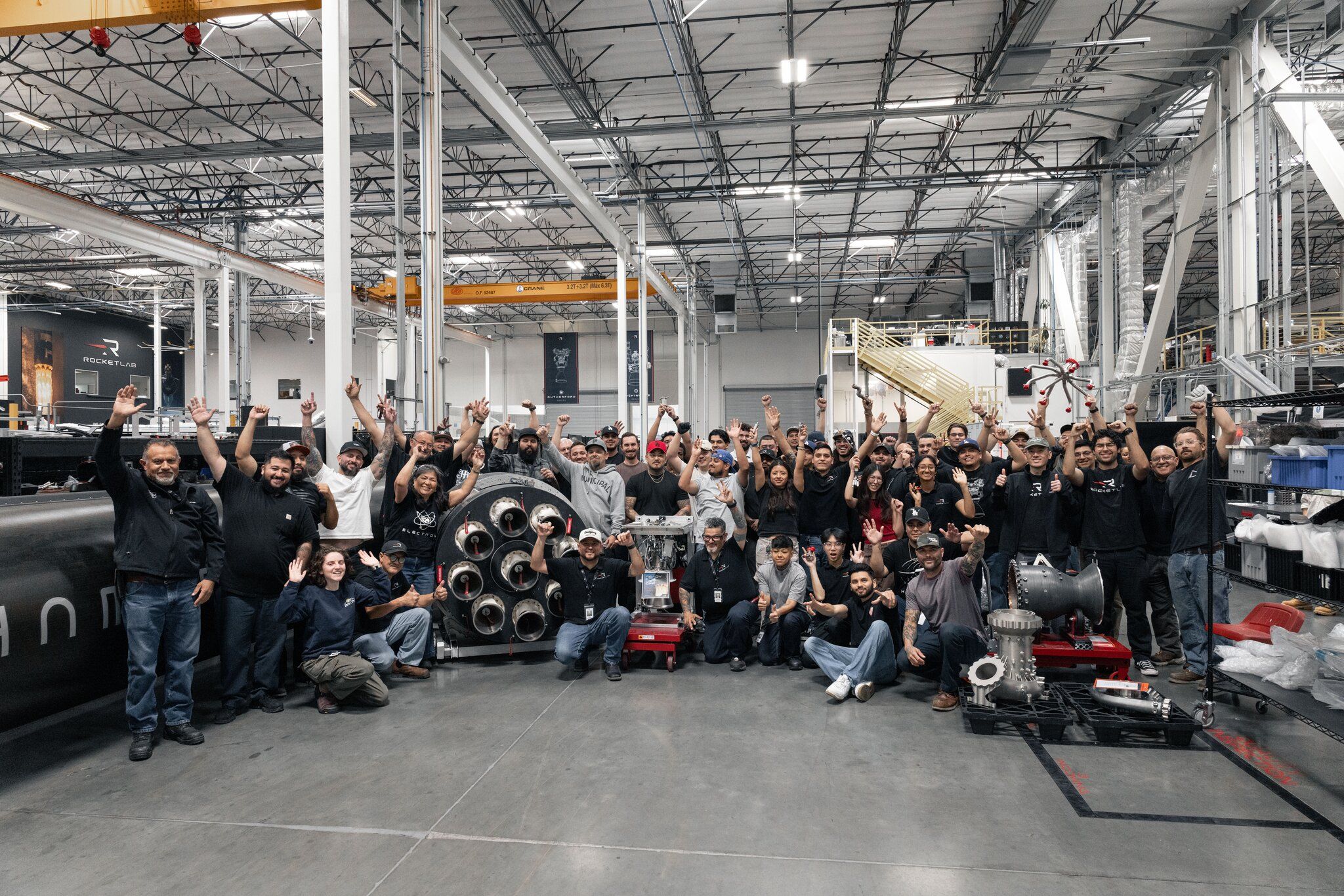
Rocket Lab completes 1,000th 3D printed Rutherford engine, marking serial production milestone for AM in aerospace propulsion

Application
Originally reported by 3D Printing Industry
Rocket Lab has completed production of its 1,000th Rutherford engine at its Long Beach, California facility, making the electric pump-fed, additively manufactured rocket engine one of the most produced orbital rocket engines in history. The Rutherford - first reaching orbit in January 2018 on the Electron launch vehicle - uses nine sea-level variants on the first stage (24 kN thrust each) and a vacuum-optimized version on the second stage. Every major component, including the combustion chamber, injectors, pumps, and propellant valves, is 3D printed using metal powder bed fusion systems from EOS, Nikon SLM Solutions, and Renishaw, with Carpenter Technology supplying the metal powders. The full engine set can be printed in a single day, and Rocket Lab's current annual production target is approximately 200 units, a dramatic acceleration from the roughly one engine per month rate during the program's earliest phase.
This milestone demonstrates that additive manufacturing has moved from aerospace propulsion novelty to repeatable, program-scale production infrastructure - a trajectory that mirrors the GE LEAP fuel nozzle's quiet embedding into certified supply chains. Rocket Lab's vertical integration strategy, combining in-house printing, powder supply, and engine assembly under one roof, has created a production model that newer entrants are now racing to replicate. South Korea's INNOSPACE launched an in-house 3D printing division in 2025 and earned ISO/ASTM 52941-20 certification for aerospace-grade metal AM systems, while LEAP 71 and HBD recently demonstrated a 200 kN 3D printed aerospike engine as a monolithic Inconel 718 part. The Rutherford's production volume - over 800 units having reached space across more than 70 Electron missions by late 2025 - places Rocket Lab in a category where AM is no longer the headline story but the underlying infrastructure enabling reliable, cost-effective launch cadence.
For the industry, the 1,000th engine confirms that metal PBF-LB can sustain serial production at aerospace qualification standards when the OEM controls the full value chain from powder to flight. The practical lesson for other propulsion developers is that vertical integration of AM capability - not just buying machines - is what enables the transition from demonstration parts to production programs. Rocket Lab's next challenge is maintaining quality consistency as output scales toward 200 engines per year, a test of whether the Long Beach facility can function as a repeatable factory rather than an impressive demo cell.
Topics