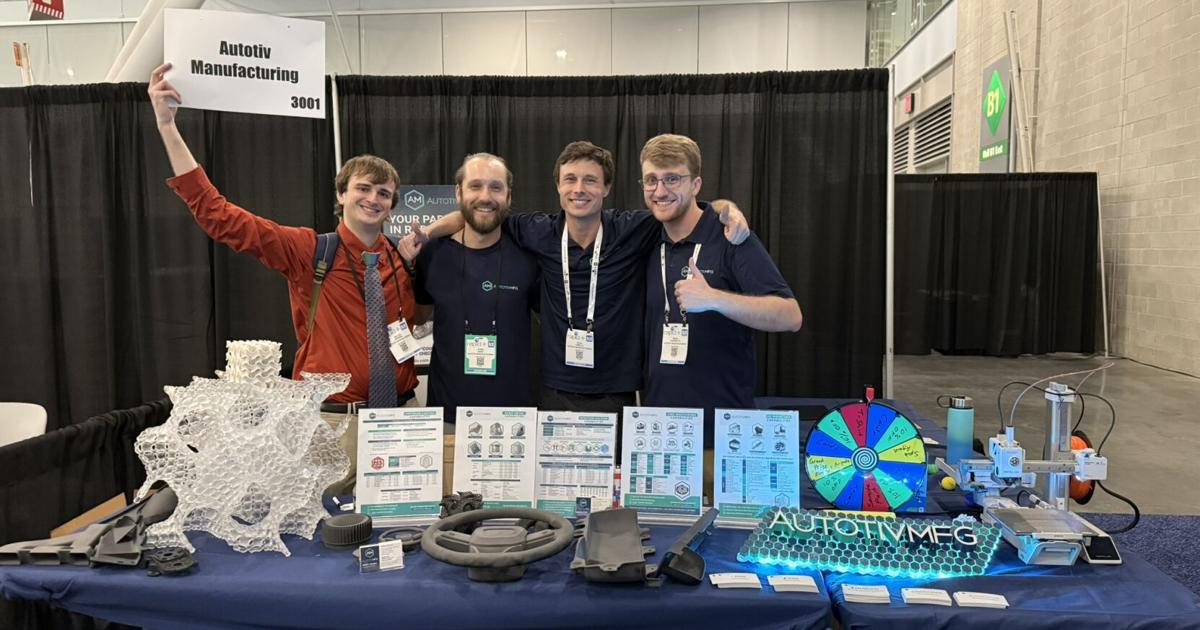
Salem entrepreneur Evan Labelle scales Autotiv Manufacturing from dorm-room hobby to 10,000-parts-per-week global service bureau
Originally reported by eagletribune.com
Evan Labelle, 30, founder of Autotiv Manufacturing in Salem, New Hampshire, has grown his high-school 3D printing hobby into a service bureau producing over 10,000 parts per week for global clients. Labelle began assembling open-source printer kits around 2012, ran machines from his college dorm room at Northeastern University, and later lived in a 600-square-foot section of his own warehouse from 2015 to 2018, reinvesting nearly all revenue. Today Autotiv employs more than 20 people and operates from a growing facility near the Salem fire department, with a fleet of hundreds of Formlabs printers forming the core of its production capacity.
Labelle’s trajectory mirrors the broader arc of the polymer AM service bureau segment, where low barriers to entry with desktop SLA/DLP systems have enabled rapid scaling but also created intense price competition. Autotiv’s reliance on Formlabs hardware - a single-vendor dependency - is notable: while it simplifies workflow and material qualification, it also ties the company’s cost structure and upgrade path to one supplier’s roadmap. The 10,000-parts-per-week figure places Autotiv in the mid-tier of production service bureaus, well below the 100,000+ parts/week volumes of leaders like Protolabs or Fictiv, but significant for a bootstrapped operation that started without venture capital. The company’s focus on fast turnaround and custom consumer goods aligns with the polymer-VPP and polymer-MEX segments, where speed-to-part often outweighs material breadth.
For Labelle, the immediate challenge is managing growth without the institutional capital that competitors use to scale. Autotiv’s next move will likely require either a shift toward higher-margin industrial or medical-dental applications - where qualification and material certification create switching costs - or a deliberate expansion into metal AM (binder jetting or LPBF) to capture higher-value work. Without that, the company risks being squeezed between low-cost Asian service bureaus and full-service Western providers with broader material portfolios. The story is a clean example of the bootstrap-to-scale pattern in polymer AM services: technically feasible, capital-efficient, but strategically narrow until the founder decides which vertical to own.
This article is an AI-assisted rewrite of the linked source report. Facts originate from the source; phrasing is AMPulse's. Use Read Original below to verify, or Report an issue if something is wrong.