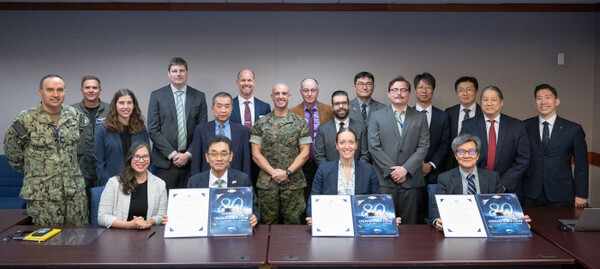
Seoul National University, US Navy Research Office, and HD Hyundai launch joint research on next-gen ship technologies including digital twin and 3D printing

Application
Originally reported by mediafine.co.kr
Seoul National University, the US Office of Naval Research (ONR), and HD Hyundai have formally launched a trilateral research collaboration focused on next-generation ship technologies. The partnership, announced on April 23, 2026, at ONR headquarters in Arlington, Virginia, includes two approved research tracks: a digital twin system for predictive ship performance led by Seoul National University and HD Hyundai, and a separate project led by HD Hyundai to advance large-scale 3D printing for shipbuilding applications. ONR will directly fund both research teams, marking a rare instance of US government R&D money flowing to a Korean industrial partner. Key figures include ONR Director Dr. Rachel Riley, Seoul National University Professor Kim Yong-hwan, and HD Hyundai Future Technology Research Institute Director Jang Kwang-pil.
This collaboration is significant because it places additive manufacturing squarely within a defense-linked maritime supply chain, a domain where AM adoption has been slow due to qualification barriers and program-length lock-in. HD Hyundai's role as the industrial lead on the large-scale 3D printing track signals that the company is moving beyond prototyping toward production-grade AM for ship components, a segment that has seen limited penetration compared to aerospace or medical. The involvement of ONR, which typically funds basic research rather than industrial scale-up, suggests that the US Navy sees strategic value in accelerating AM for naval shipbuilding, potentially to reduce reliance on traditional casting and forging supply chains. This aligns with the broader defense-driven AM wave observed in 2025-2026, where policy and funding are creating new entry points for AM in military platforms.
For HD Hyundai, this is a concrete step toward embedding AM into its shipbuilding workflow, but the real test will be whether the research translates into qualified, production-ready parts that meet naval certification standards. The company must now demonstrate that its large-format AM systems can deliver repeatable mechanical properties at the scale and cost required for ship components, a challenge that has tripped up many industrial AM programs before. If successful, this could open a new demand vertical for metal AM in the energy and defense maritime sectors, but the timeline to qualification will likely be measured in years, not quarters.
This article is an AI-assisted rewrite of the linked source report. Facts originate from the source; phrasing is AMPulse's. Use Read Original below to verify, or Report an issue if something is wrong.
Topics