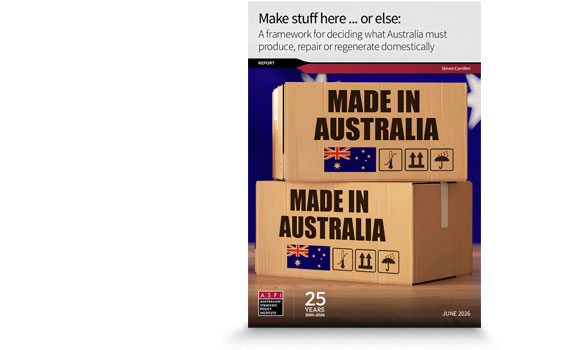
SPEE3D co-founder Steven Camilleri authors ASPI report on Australian industrial sovereignty framework

Hardware
Originally reported by Metal AM
Steven Camilleri, co-founder and Chief Technology Officer of SPEE3D, has authored a report published by the Australian Strategic Policy Institute (ASPI) titled 'Make stuff here … or else: A framework for deciding what Australia must produce, repair or regenerate domestically.' The report introduces the concept of a 'sovereignty countdown,' defined as the length of time a critical system can continue operating if external supply is disrupted, relying solely on existing reserves, substitutes, and domestic capabilities. It cites examples such as water-treatment chemicals held for only weeks, diesel reserves stored in weeks rather than months, and imported fertilisers whose disruption may not affect crop yields until the subsequent harvest. The report calls for a national resilience test for critical infrastructure operators, minimum national survival thresholds, and financing mechanisms including a continuity investment window and mobilisation of superannuation capital.
This report matters because it translates AM industry capability into a national security and policy framework, moving beyond the typical machine-spec or production-volume narratives. SPEE3D, known for its cold spray DED technology deployed by the Australian Defence Force and allied militaries, is positioned at the intersection of defense logistics and distributed manufacturing. The 'sovereignty countdown' concept directly addresses the defense vertical's accelerating adoption of AM for on-demand spare parts and field repair, particularly in the politically accelerated 2025-26 wave of defense AM investment. It also aligns with the broader pattern of Chinese localization pressure and the need for Western nations to maintain domestic production of critical components, especially in metal AM where supply chains for powders and lasers are increasingly contested.
From an AM industry perspective, this report provides a measurable, engineering-based rationale for defense and government investment in distributed AM capabilities, rather than relying on abstract policy goals. For SPEE3D, it reinforces their strategic positioning as a supplier of deployable, ruggedised metal AM systems for military logistics, and may accelerate procurement cycles as defense organisations operationalise the sovereignty countdown metric. The practical next step is for SPEE3D and other defense-focused AM vendors to align their product roadmaps with the specific resilience thresholds and system-level requirements that this framework will likely generate in Australian and allied defense procurement.
This article is an AI-assisted rewrite of the linked source report. Facts originate from the source; phrasing is AMPulse's. Use Read Original below to verify, or Report an issue if something is wrong.
Topics