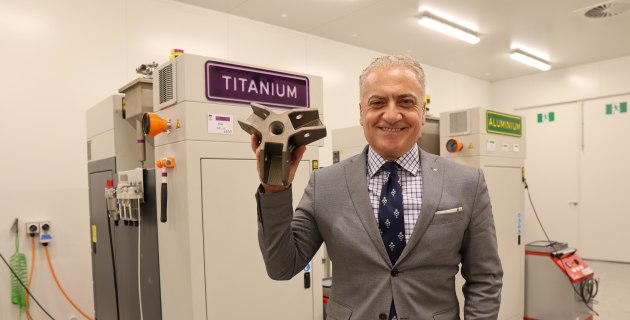
Stärke-AMG adds three Renishaw AM400 LPBF systems at Camden Park facility

Service
Originally reported by australiandefence.com.au
Stärke Advanced Manufacturing Group (AMG), in partnership with Flinders University, has installed three Renishaw AM400 laser powder bed fusion systems at its Camden Park facility in South Australia. The machines, initially acquired by Flinders for research, are being transitioned into production to serve defense, space, and medical clients. One unit will support a new Additive Manufacturing Cooperative Research Centre project with Flinders, the University of Adelaide, and Metal Powder Works. CEO Al Jawhari noted the systems expand Stärke beyond its existing Arcam electron beam melting platforms into stainless steel, aluminum, and Inconel alloys, targeting ASC and US Navy certification within months.
This expansion underscores a recurring pattern in the additive manufacturing industry: academic research equipment migrating to commercial production as demand for qualified metal parts grows-particularly in defense supply chains constrained by AUKUS requirements. Stärke’s move to complement EBM with LPBF gives it a multi-process metal capability rare in Australia, directly addressing the gap between traditional manufacturing and the need for complex, small-batch, digitally enabled components. The investment also aligns with the broader push to reduce reliance on imported parts for defense and critical infrastructure, a theme accelerated by policy shifts favoring domestic sourcing and allied digital design sharing.
For the Australian defense and advanced manufacturing ecosystem, Stärke’s certification timeline will be the real test: securing ASC and US Navy qualification is a multi-year grind requiring rigorous process control and material traceability, not just machine installation. The immediate demand signal-orders for water pump parts and targeting space/energy opportunities-suggests production viability, but the company must now demonstrate repeatable qualification throughput across multiple alloys and programs. If successful, this could serve as a template for other regional service bureaus looking to bridge academic capability and defense production under AUKUS frameworks.
Topics