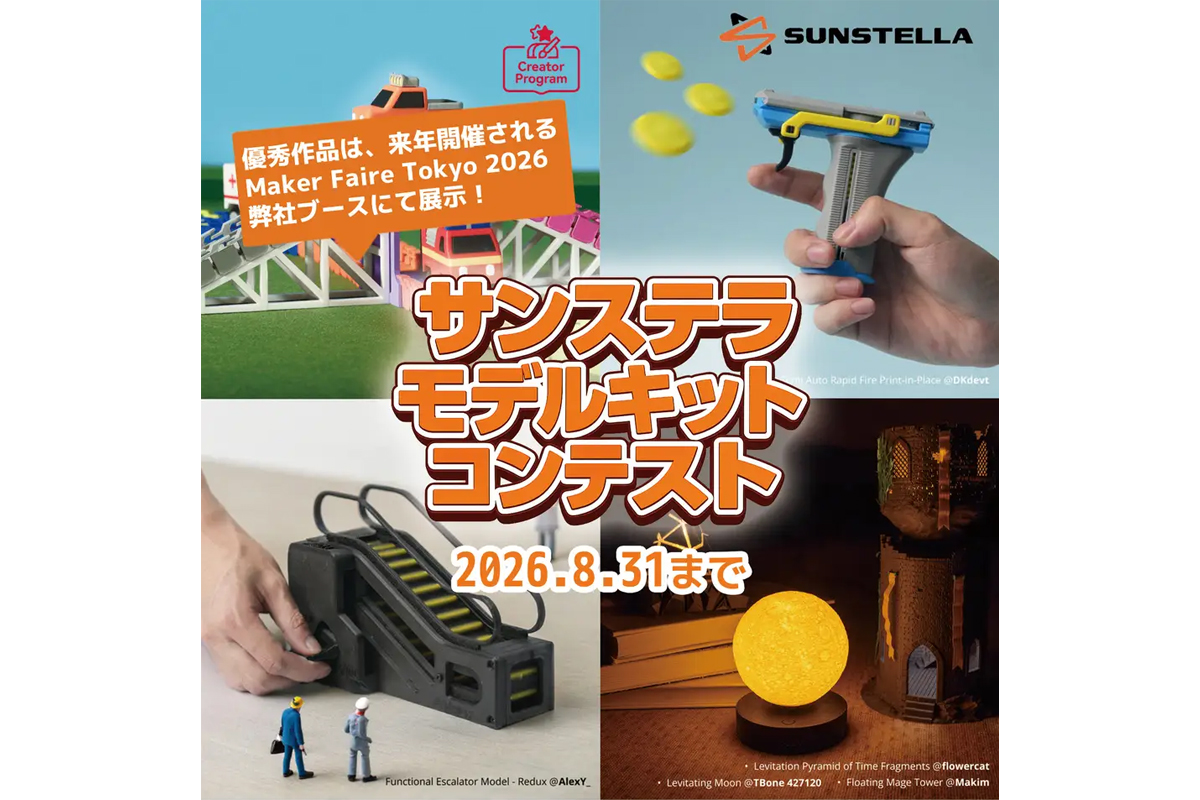
Sunstella launches 'Model Kit Modeling Contest' for 3D-printed works, plans Maker Faire Tokyo 2026 exhibition

Service
Originally reported by ShareLab
Sunstella Co., Ltd., a Japanese distributor of 3D printers and related products, has announced the 'Sunstella Model Kit Modeling Contest,' a competition for 3D-printed works open to beginners and experienced users alike. The contest runs from April 23 to August 31, 2026, and requires participants to use one of three kits purchased from Sunstella: a Starter Kit, a Magnetic Levitation DIY Kit, or a SnapaTrack Kit. Prizes include a 3D printer valued at up to 150,000 JPY (approx. $1,000 USD) for the grand prize winner, three A1 mini 3D printers for excellence awards, and Polymaker filament spools for ten special award winners. Winning entries will be displayed at Sunstella's booth during Maker Faire Tokyo 2026, held September 5-6 at Ariake GYM-EX in Tokyo.
This initiative addresses a persistent bottleneck in the consumer and prosumer polymer AM market: the gap between printer ownership and sustained creative output. While desktop FDM/FFF printer sales have grown rapidly in Japan, many users stall after initial calibration prints, lacking project inspiration or community validation. Sunstella's contest design - low barrier to entry, kit-based constraints, and a physical exhibition endpoint - mirrors patterns seen in the broader maker ecosystem, where structured challenges (e.g., Hackaday Prize, Prusa contests) drive engagement and skill progression. The contest also serves as a marketing funnel for Sunstella's own kit products and for Bambu Lab printers (the A1 mini is a Bambu Lab model), reinforcing the distributor's position in Japan's consumer AM value chain. This is a small but strategically coherent move for a distributor seeking to deepen user stickiness beyond hardware sales.
From a practical standpoint, Sunstella's contest is unlikely to shift industry-level metrics, but it reflects a sound understanding of local market dynamics. The company's real challenge will be execution: ensuring clear judging criteria, managing submission volume, and delivering a compelling exhibition experience at Maker Faire Tokyo. For Japanese hobbyists and educators, this is a low-risk opportunity to gain exhibition exposure and hardware prizes. For competitors like Yamazen or other domestic distributors, it signals that community-building initiatives are becoming a competitive differentiator in the Japanese consumer AM space.
Topics