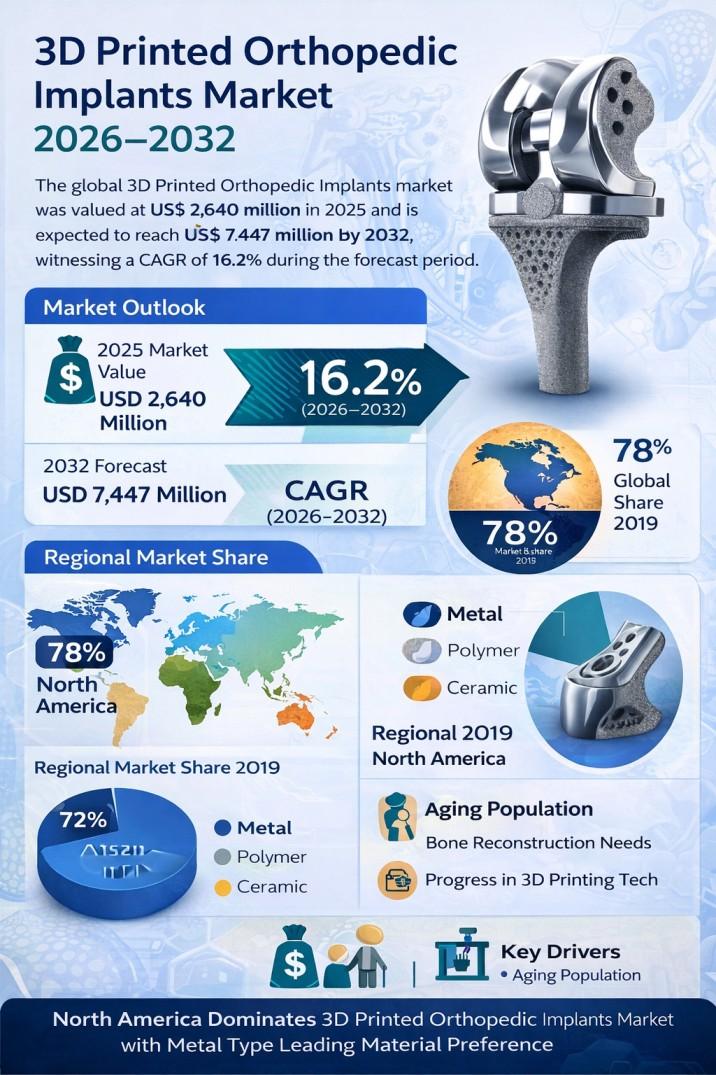
The global 3D printed orthopedic implants market is projected to reach 7447 million dollars by 2032, driven by a 16.2 percent CAGR.
Technology
1 min read

The global 3D printed orthopedic implants market is projected to reach 7447 million dollars by 2032, driven by a 16.2 percent CAGR.

Originally reported by OpenPR

The global 3D printed orthopedic implants market is projected to reach 7447 million dollars by 2032, driven by a 16.2 percent CAGR. While metals currently hold a 72 percent share, the industry is shifting toward point-of-care manufacturing using advanced PEEK and bioresorbable materials. This marks a transition from centralized production to decentralized hospital-based fabrication for custom patient care. Such a model significantly reduces lead times and enables real-time surgical personalization. 🏥⚙️

How This Connects

6 related events
  1. Same pattern

    Spellman Care and the University of Leeds Collaborate to Develop 3D Printed Food for Elderly Dysphagia Patients

  2. Same pattern

    XCath, a Houston-based medical robotics firm, secured $30M in Series C funding led by Crescent Enterprises and Dr.

  3. Same pattern

    Leitat has achieved ISO 13485:2018 certification for 4 categories of personalized medical devices, a first for a Spanish tech center.

  4. Same pattern

    Croom Medical has broken ground on its 38,000 sq ft Advanced Centre of Orthopaedic Technologies in Limerick, marking an 18 million euro investment.

  5. This article

    The global 3D printed orthopedic implants market is projected to reach 7447 million dollars by 2032, driven by a 16.2 percent CAGR.

  6. Same pattern

    Nivalon Medical is redefining spinal care by utilizing AI-driven design and XJet ceramic 3D printing to create the EvoFlex patient-specific implant.

  7. Same pattern

    3D Controls and KICET completed their 2025 advanced ceramic 3D printing training, expanding to three annual sessions in 2026.