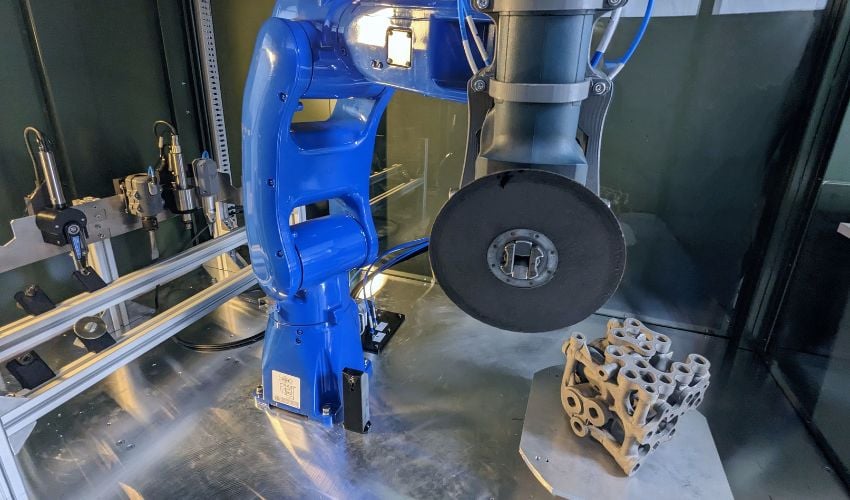
UK Dstl Funds Rivelin Robotics to Automate Post-Processing for Defense AM Parts

Post-Processing
Originally reported by 3DNatives
The UK Defence Science and Technology Laboratory (Dstl) has awarded funding to Rivelin Robotics to deploy its NetShape robotic post-processing systems for defense applications. The funding, channeled through the UK Defence and Security Accelerator, supported Rivelin in transitioning its microfactory concept into production-ready hardware. Rivelin’s r1000 system performs hammering, chiselling, cutting, milling, grinding, polishing, drilling, and 3D scanning on metal, polymer, and ceramic parts. The company claims the r1000 delivers five times the productive hours of manual finishing at a quarter of the labor, energy, and training cost. As of May 15, 2026, Rivelin has sold microfactories to five customers across aerospace, medical, automotive, and energy verticals, and is now expanding into defense alongside new offices in Spain, France, Germany, and the United States.
This development addresses a persistent bottleneck in additive manufacturing: post-processing remains labor-intensive, inconsistent, and expensive, especially for complex geometries that require support removal and surface finishing. By automating these steps with robotic dexterity and perception, Rivelin targets the economic viability of AM production at scale - particularly for defense, where on-demand manufacturing and supply-chain resilience are strategic priorities. The Dstl’s involvement signals that post-processing automation is no longer a niche efficiency play but a recognized enabler for operational readiness. Rivelin competes indirectly with automated finishing solutions from PostProcess Technologies and DyeMansion, but its focus on multi-material, multi-tool robotic cells for metal and ceramic parts differentiates it in the high-value defense and aerospace segments. The company’s expansion into the US and continental Europe positions it to capture demand from both defense primes and commercial AM service bureaus.
For Rivelin, the immediate challenge is scaling from five customer deployments to repeatable, certified production lines that meet defense qualification standards. The Dstl funding provides credibility and a reference customer, but the company must now demonstrate that its microfactories can integrate with existing AM workflows and deliver consistent part quality across different materials and geometries. Buyers evaluating robotic post-processing should assess Rivelin’s ability to handle their specific part families and material sets, particularly for titanium and nickel superalloys common in defense applications. The technology is promising, but the path from early-adopter sales to defense-program qualification is long and requires sustained investment in process validation and customer support.
Topics