VoxelDance Additive launches thermal management module for metal 3D printing with implicit modeling workflow
Originally reported by 南极熊3D打印网
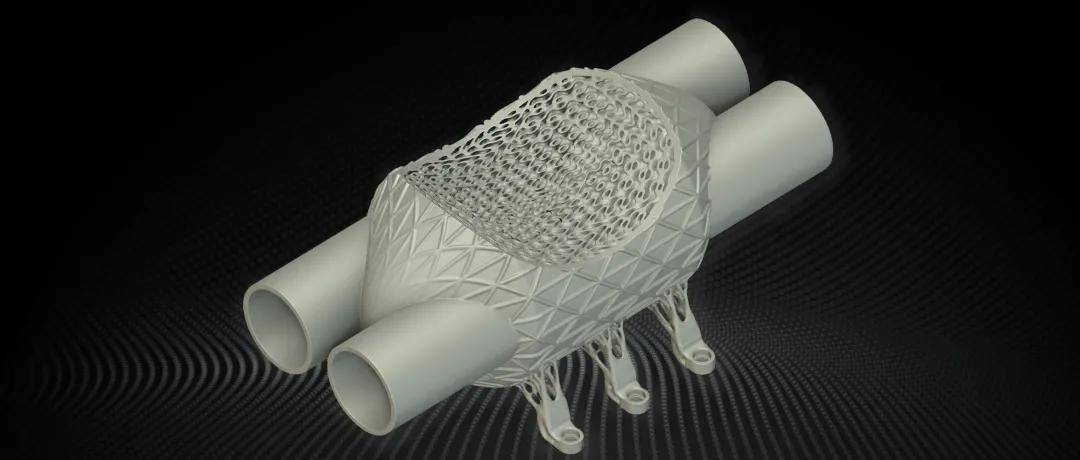
Chinese AM software developer VoxelDance Additive has released a dedicated thermal management module for metal additive manufacturing, targeting the growing demand for complex heat exchanger and cooling channel design. The module, integrated into the company's existing VoxelDance Additive platform, leverages implicit modeling to enable parametric generation of TPMS structures, lattice geometries, and conformal cooling channels. It also supports field-driven lattice design, allowing users to vary porosity and wall thickness based on thermal or stress load inputs, and provides a unified design-to-print workflow that reduces data conversion steps. The release comes as defense primes including Lockheed Martin and Northrop Grumman increasingly adopt AM for hypersonic weapons, missile components, and advanced thermal management systems.
This launch addresses a critical bottleneck in the metal AM value chain: the design gap between traditional CAD and the complex geometries that AM can produce. While hardware for copper and high-conductivity alloy printing has advanced rapidly-particularly with green-wavelength LPBF systems-the software toolchain for designing efficient heat exchangers, cold plates, and integrated cooling structures has lagged. VoxelDance Additive competes in a space occupied by nTop, Altair, and Siemens NX AM, but its implicit modeling approach is particularly well-suited to the large data volumes and iterative design cycles typical of thermal management applications. The module's field-driven design capability aligns with the aerospace qualification grind pattern, where parts must be optimized for non-uniform thermal loads rather than uniform lattice infill. For Chinese defense and aerospace contractors, this software reduces reliance on Western tools, supporting the broader localization arc in AM software.
For users evaluating this module, the practical test will be whether it can handle production-scale heat exchanger models without performance degradation and whether the design-to-print workflow integrates smoothly with common LPBF machine toolchains. VoxelDance Additive must demonstrate that its implicit modeling engine can match the robustness of established Western competitors while offering faster iteration for Chinese defense programs. The module is a logical extension of the company's existing build preparation software, but its success depends on adoption by thermal engineers who are not AM specialists.
This article is an AI-assisted rewrite of the linked source report. Facts originate from the source; phrasing is AMPulse's. Use Read Original below to verify, or Report an issue if something is wrong.