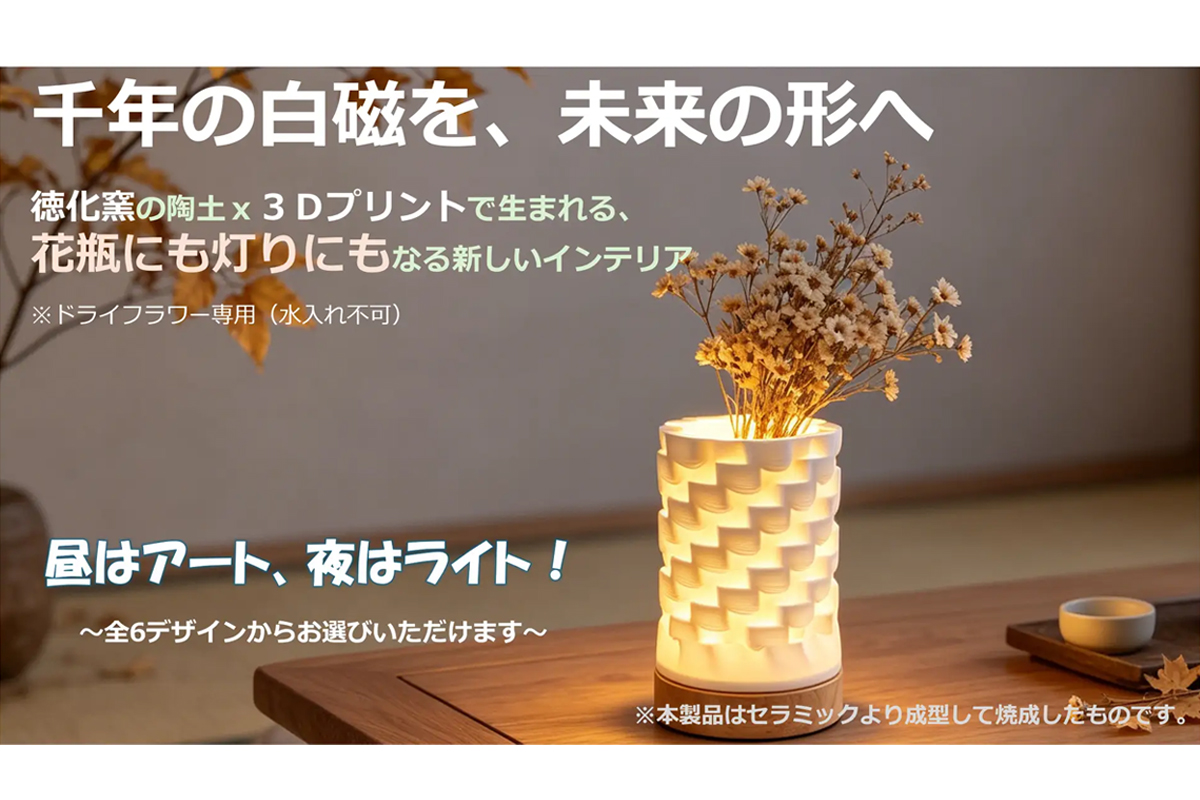
YOUZ launches 3D-printed ceramic interior collection on Makuake using Dehua white porcelain

Application
Originally reported by ShareLab
Japanese product development firm YOUZ has launched a crowdfunding campaign on Makuake for a line of 3D-printed ceramic interior products, developed in partnership with Xiamen DEZTOOL Technology Co., Ltd. The collection, titled "Day as Art, Night as Light (2WAY) - 3D Printing Interiors That Design Light," features six models - Silent Ripple, Whispering Clay, Lattice Glow, Flow Veil, Golden Drop, and Twilight Flame - each functioning as both a dry-flower vase and a USB-powered LED indirect light. The products are made from Dehua white porcelain clay sourced from Fujian Province, China, a material with over 1,000 years of craft history, and are formed using a dedicated 3D ceramic printer. Each piece measures approximately 8×13 cm, weighs about 400 g, and is hand-finished and inspected, giving every unit a unique surface character.
This launch sits at the intersection of two underappreciated AM frontiers: ceramic additive manufacturing and the direct-to-consumer interior design vertical. While most AM industry attention focuses on metal LPBF for aerospace and medical, ceramic 3D printing remains a niche but growing segment, with applications in art, architecture, and luxury goods. YOUZ and DEZTOOL are leveraging the geometric freedom of 3D printing to create lattice and organic forms that would be impractical or impossible with traditional slip-casting or hand-throwing. The Makuake platform provides a low-risk, high-visibility channel to test Japanese consumer appetite for digitally fabricated craft objects, a pattern that mirrors how desktop FDM and resin printers first found product-market fit through crowdfunding. The partnership also highlights a recurring value-chain dynamic: a Japanese design and marketing firm pairing with a Chinese manufacturing partner that controls the material and process technology.
From a practical standpoint, this is a small-scale product launch, not an industrial breakthrough. The real test for YOUZ and DEZTOOL will be whether they can move beyond crowdfunding batches to consistent, repeatable production without sacrificing the hand-finish quality that justifies the craft premium. For the broader AM industry, the project is a useful reminder that ceramic 3D printing, while far from the revenue scale of metal or polymer AM, can find viable commercial niches in high-design consumer goods where shape complexity and material heritage command a price premium. The key metric to watch is not unit volume but whether the campaign funds and whether repeat orders follow.
This article is an AI-assisted rewrite of the linked source report. Facts originate from the source; phrasing is AMPulse's. Use Read Original below to verify, or Report an issue if something is wrong.