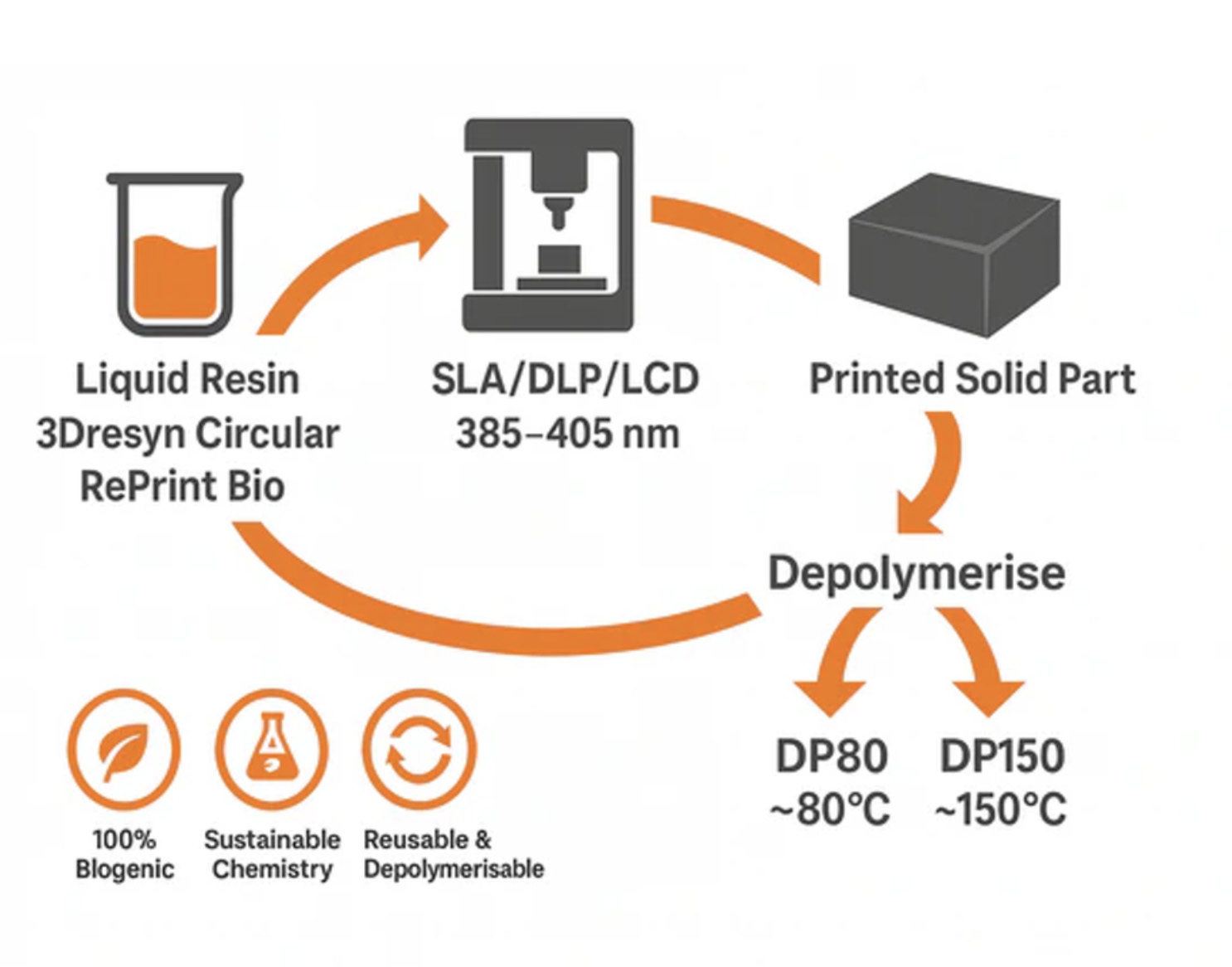
3Dresyn launches Circular RePrint Bio depolymerizable resin for SLA/DLP/LCD at €700/L

Materials
Originally reported by 3Druck
Spanish materials startup 3Dresyn has introduced Circular RePrint Bio, a photopolymer resin for SLA, DLP, and LCD printers (385–405 nm) that can be thermally depolymerized back into a reusable syrup. Available in two variants - DP80, which depolymerizes at 80°C, and DP150, which requires 150°C - the material enables a closed-loop process where printed parts are converted back to liquid in an oven or warm bath within 10–60 minutes. A liter is priced at €700 and is currently listed as sold out on the company’s website. The resin targets iterative prototyping workflows where the same batch of material can theoretically be reused across multiple design cycles.
This launch addresses a structural gap in polymer vat photopolymerization: the absence of practical end-of-life recycling for thermoset resins. Conventional SLA/DLP materials undergo irreversible crosslinking, meaning scrap parts and support structures become waste. 3Dresyn’s approach, while chemically distinct from standard acrylate formulations, introduces a depolymerization mechanism that could reduce material consumption in early-stage prototyping and design validation. However, the high per-liter cost and lack of published data on mechanical property retention across cycles, toxicity profiles, and long-term stability mean the material remains a niche proposition. The company has not disclosed whether the recycled syrup maintains identical print behavior after multiple loops, nor whether the chemistry is compatible with existing printer warranties or safety protocols.
For users evaluating Circular RePrint Bio, the practical question is whether the per-cycle cost savings from reuse offset the upfront premium and the added workflow complexity of thermal depolymerization. The material is best suited for controlled lab or service-bureau environments where part geometry is iterated frequently and waste disposal costs are a factor. 3Dresyn must now deliver transparent cycle-life data and safety documentation to move beyond early adopter curiosity. Until then, this is an interesting materials-science experiment, not a drop-in replacement for standard resins.
Topics