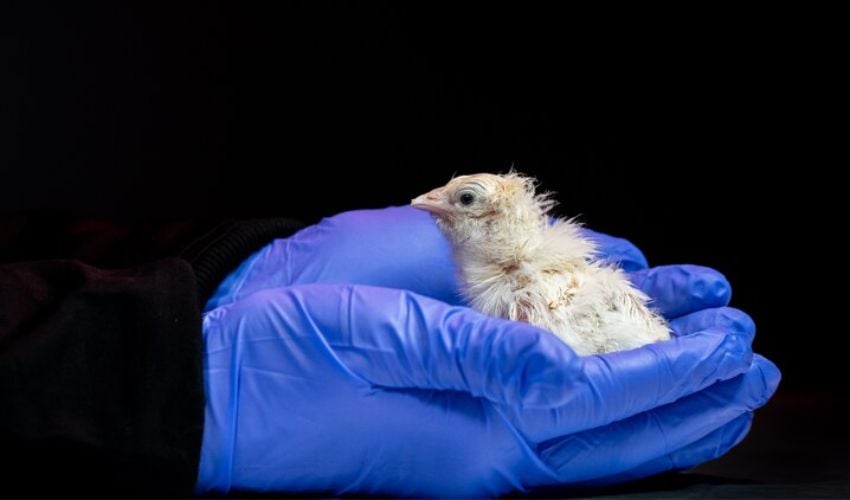
Colossal Biosciences hatches 26 chicks using 3D-printed artificial eggs in de-extinction effort
Originally reported by 3DNatives
Colossal Biosciences, the Dallas-based de-extinction biotechnology company, announced last week that it successfully hatched 26 healthy chickens using 3D-printed artificial eggs. The artificial eggs feature a dual-component design: a semi-permeable silicone membrane housed within a rigid hexagonal support cup, with prototypes printed on a Formlabs Form 4 using BioMed black resin and final iterations made in titanium. The silicone membrane replicates the gas-exchange function of a natural eggshell, enabling passive oxygen diffusion and eliminating the need for supplemental concentrated oxygen that can damage developing embryo DNA. The design includes a clear observation window and can be scaled from hummingbird-sized eggs to the soccer-ball-sized eggs of the South Island giant moa, which stood nearly 12 feet tall.
This proof-of-concept matters because it solves a persistent biological engineering bottleneck that has limited avian developmental biology and conservation efforts. Previous shell-free hatching systems using plastic cups or saran wrap achieved low success rates due to oxygen toxicity and contamination risks. Colossal's approach - combining additive manufacturing for precise geometric control with materials science for gas permeability - demonstrates how AM can serve as infrastructure for complex biological workflows rather than merely producing end-use parts. The artificial egg technology has immediate applications beyond de-extinction: it provides a platform for developmental biology research, avian conservation breeding programs, and potentially commercial poultry science. For Colossal, which has raised over $600 million since its 2021 founding and carries a $10 billion valuation, this milestone validates a critical enabling technology for its dodo and moa projects, though the company still needs to solve primordial germ cell editing and surrogate species selection before achieving actual de-extinction.
From a practical standpoint, this is a materials and process engineering achievement, not a de-extinction breakthrough. The 26 chicks were unmodified chickens transferred from natural shells into artificial ones - the genetic engineering required to produce a functional dodo or moa remains years away. Colossal's next concrete milestones will be scaling the artificial egg system for larger avian species and demonstrating that primordial germ cell editing can produce viable embryos. For the AM industry, this case reinforces that polymer and metal additive manufacturing can serve specialized scientific instrumentation roles where custom geometry and material properties are more important than production volume or cost per part.
This article is an AI-assisted rewrite of the linked source report. Facts originate from the source; phrasing is AMPulse's. Use Read Original below to verify, or Report an issue if something is wrong.
Topics