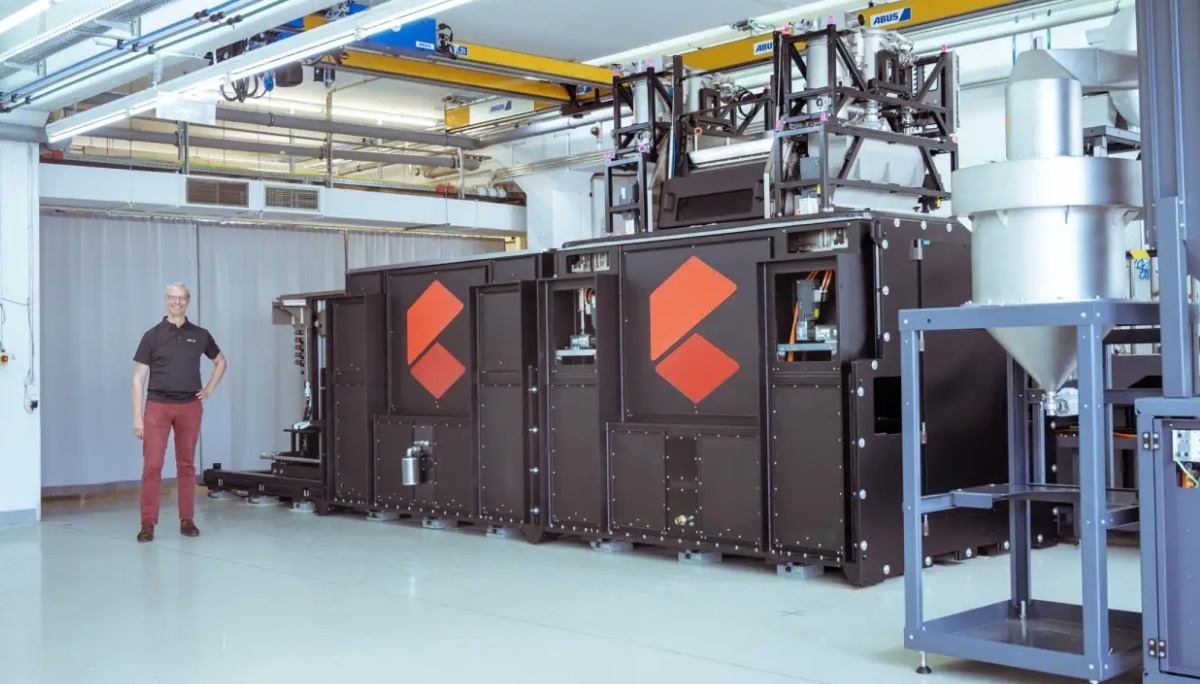
ACMI Becomes First Global Operator of AMCM M 8K Large-Format Metal LPBF System.

Hardware
Originally reported by DailyCADCAM
ACMI Becomes First Global Operator of AMCM M 8K Large-Format Metal LPBF System. The American Center for Manufacturing and Innovation (ACMI) has acquired the first AMCM M 8K metal additive manufacturing system, a platform developed by the EOS customization subsidiary AMCM. The machine features a build volume of 800 x 800 x 1,200 mm and is powered by eight 1.2 kW nLIGHT lasers. It incorporates AirSword gas flow technology to manage atmospheric conditions across the large build area and utilizes EOSPrint software with Dynamic Scan Fields for optimized laser exposure. This deployment is intended to support the production of mission-critical aerospace and defense components, including rocket engines and missile structures, by leveraging the system's ability to handle four tons of powder along the Z-axis.
This acquisition represents a strategic move to bridge the gap between high-precision LPBF and the requirements for ultra-large metal components. While DED systems have traditionally dominated the large-format space, they often lack the fine resolution and surface finish required for complex aerospace geometries. The AMCM M 8K competes directly with other large-frame LPBF solutions by maintaining a fixed-scanner architecture, which avoids the mechanical complexity and potential calibration drift associated with moving optics. By integrating this system, ACMI aims to enhance the domestic industrial base, addressing the need for scalable, high-reliability metal production that maintains the metallurgical consistency of smaller-scale LPBF processes.
The adoption of the M 8K confirms a clear market preference for scaling LPBF technology rather than pivoting to lower-resolution deposition methods for large-scale aerospace parts. Success for ACMI will depend on their ability to validate the thermal management and gas flow consistency of the AirSword system during extended, multi-day build cycles. Users should evaluate this platform based on its ability to maintain part-to-part repeatability across the 0.76 cubic meter build volume, particularly when processing reactive materials like copper alloys or high-strength superalloys.
This article is an AI-assisted rewrite of the linked source report. Facts originate from the source; phrasing is AMPulse's. Use Read Original below to verify, or Report an issue if something is wrong.