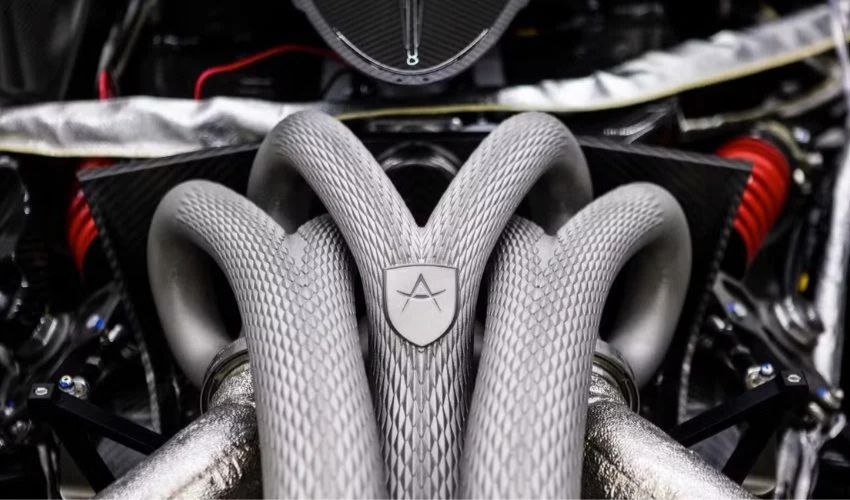
Apollo Automobil produces largest single-piece 3D-printed exhaust in TA15 aerospace alloy with dragon-scale texture

Application
Originally reported by 3DNatives
Apollo Automobil, the German hypercar manufacturer, has revealed that its new Apollo EVO supercar features a single-piece 3D-printed titanium exhaust system, which it claims is the largest such component ever produced. The exhaust was fabricated using advanced laser powder bed fusion (LPBF) over 123 hours, utilizing TA15 aerospace-grade titanium alloy for exceptional thermal and structural performance. The part incorporates a dragon-scale texture that is both aesthetic and functional, improving heat distribution across the structure, and is finished with a ceramic coating rated to 1,000°C. The Apollo EVO, priced at $4 million, is a track-only evolution of the Apollo Intensa Emozione (IE), powered by a Ferrari F140 V12 engine producing 800 hp, with only 10 units planned for production.
This application sits at the intersection of automotive exclusivity and metal AM production capability, but it is not a volume story. The exhaust is a low-volume, high-value component for a $4 million hypercar, where design freedom and material performance justify the 123-hour build time and premium material cost. The use of TA15 alloy, a near-alpha titanium typically reserved for aerospace structural and engine components, underscores the thermal and mechanical demands of the application. While the dragon-scale texture is a design flourish, the functional claim of improved heat distribution suggests genuine engineering integration rather than pure ornamentation. This is a showcase of what metal AM can achieve at the extreme high end of automotive, but it does not signal a broader shift toward production-scale AM in automotive exhaust systems, where cost and throughput remain prohibitive for serial applications.
From a practical standpoint, this is a successful engineering demonstration that reinforces the value of AM for bespoke, high-performance components where conventional fabrication would be impossible or prohibitively expensive. The real test for Apollo will be whether the exhaust meets durability and emissions standards for track use, and whether the company can replicate this level of integration across other vehicle systems. For the AM industry, this serves as a reference case for design-led metal AM in luxury automotive, but it remains a niche application with limited direct implications for the broader automotive supply chain.
Topics