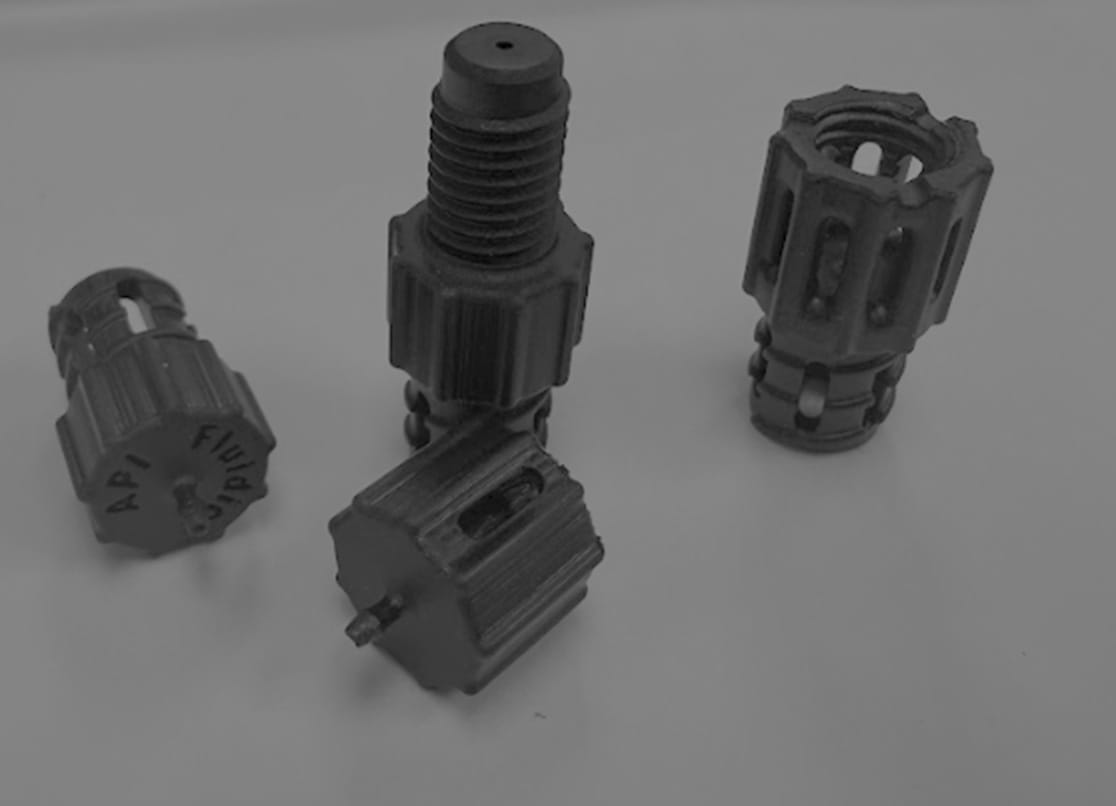
Astoria-Pacific International certifies 3D printed fluidic fittings on Carbon DLS for medtech market

Service
Originally reported by TCT Magazine
Astoria-Pacific International, a US-based engineering and production services firm, has developed and certified ISO 13485-compliant 3D printed fluidic fittings using Carbon's Digital Light Synthesis (DLS) platform. The fittings, produced for Darwin Microfluidics, leverage Carbon's functional material to achieve tight tolerances, thin walls, and complex internal channels that match injection-molded performance. Whitney Menzel, Senior Manager at Astoria-Pacific, and Isabelle Palumbo, Senior Strategic Account Manager at Carbon, are presenting the case study in a July 2026 webinar that details the full journey from material selection through production scale-up. The parts are designed as white-labelable components that aim to deliver premium quality at budget-friendly cost points, directly challenging the traditional expensive-or-cheap tradeoff in microfluidic fittings.
This case study fits squarely into the polymer-vpp segment frontier, where vat photopolymerization technologies like Carbon's DLS are steadily moving from prototyping into certified production for medical-dental applications. The medical-dental vertical has long been the largest production user of polymer AM, driven by Align Technology's massive VPP-based aligner production, but the certification of fluidic components under ISO 13485 represents a meaningful expansion into functional, fluid-handling devices rather than just anatomical models or surgical guides. The development also illustrates the recurring pattern of service bureaus acting as qualification bridges: Astoria-Pacific absorbs the certification burden and production risk, allowing end-users like Darwin Microfluidics to access AM without building internal expertise. This service-led adoption model is increasingly critical as medical device manufacturers seek to bypass the long qualification grind that has historically slowed AM penetration in regulated environments.
For the broader medtech market, the practical takeaway is that Carbon's DLS platform, combined with a qualified service partner, can now deliver ISO 13485-certified fluidic components at production volumes. The key execution challenge for Astoria-Pacific will be maintaining repeatable quality across batch runs and demonstrating cost parity with injection molding at scale. Buyers evaluating similar applications should focus on material data sheets for biocompatibility and long-term fluid resistance, not just initial print accuracy. This is a concrete step forward for polymer AM in medical devices, but it remains one certified application, not a wholesale market shift.
This article is an AI-assisted rewrite of the linked source report. Facts originate from the source; phrasing is AMPulse's. Use Read Original below to verify, or Report an issue if something is wrong.
Topics