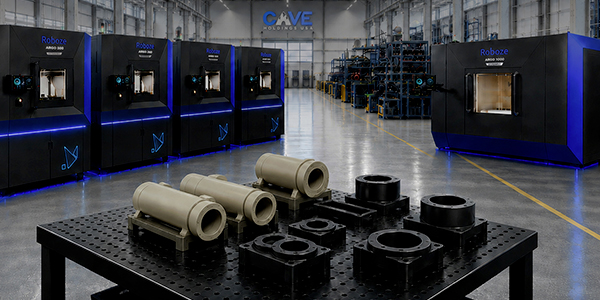
Cave Holdings installs ROBOZE ARGO 1000 HYPERMELT 3D printer to expand fleet

Service
Originally reported by TCT Magazine
Cave Holdings USA, an advanced manufacturing service provider, has installed a ROBOZE ARGO 1000 HYPERMELT system, adding to a fleet that already includes one upgraded ARGO 500 HYPERSPEED and six ARGO 500 machines. The large-format polymer extrusion printer expands the company's capacity for high-performance, production-grade parts serving energy, aerospace, and defense customers. President Angela Kilic-Cave framed the move as a commitment to real production environments, not experimentation, citing supply chain resilience and design flexibility as core drivers. ROBOZE CEO Alessio Lorusso noted that the installation reflects a broader shift from prototyping to scalable additive production.
This expansion is a concrete signal of service bureau maturation-a dominant but often overlooked segment of the AM economy. Cave Holdings is not buying a flagship machine for marketing; it is fleet-deepening to meet demand from sectors where isolated or high-cost supply chains make on-demand manufacturing economically compelling. The ARGO 1000 HYPERMELT targets large-format high-temperature polymers, a process niche within material extrusion that competes with systems from BigRep, Stratasys, and 3D Systems. For defense and energy, the value proposition hinges on reducing lead times for non-metallic components without the qualification burden of metal AM. The investment aligns with the broader trend of service providers becoming the largest revenue pool in AM-outpacing printer OEMs-and underscores that production adoption is increasingly measured in repeat orders rather than machine unveilings.
This is a sensible capacity addition, not a market-shaking event. For Cave Holdings, the execution challenge lies in proving that the ARGO 1000 can deliver consistent throughput for demanding customers, not just flashy prototypes. Industry buyers evaluating large-format polymer AM should benchmark real cycle times, material properties, and post-processing requirements before committing to similar expansion. The move reinforces that service-led adoption continues to outpace end-user direct in-house deployment for many industrial polymer applications.
Topics