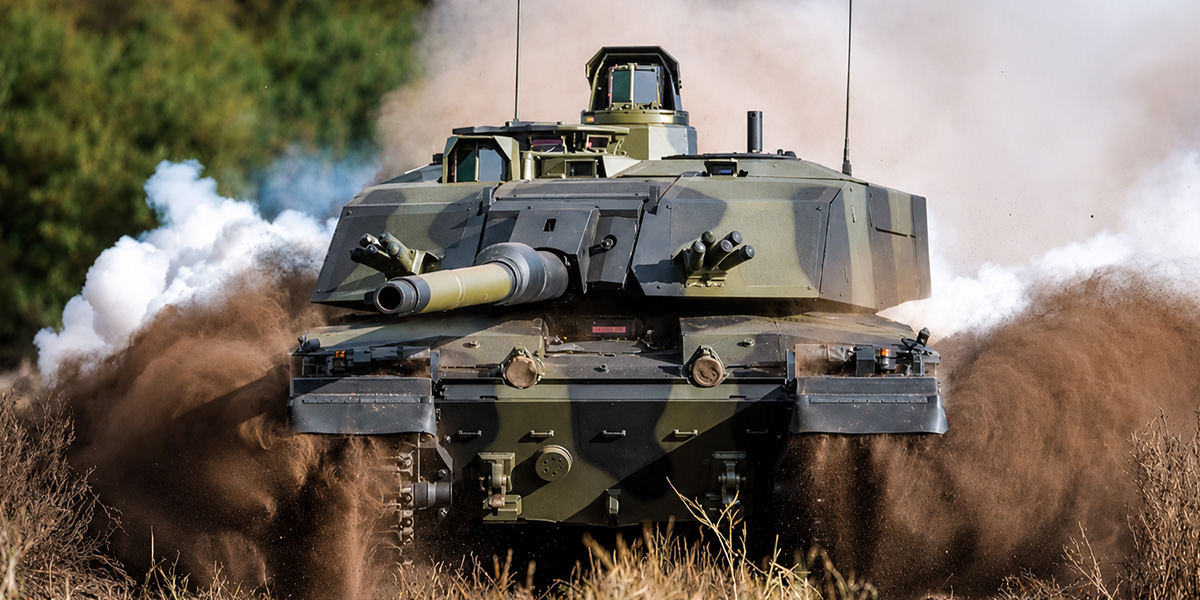
Rheinmetall UK integrates FFF into Challenger 3 production as baseline method

Application
Originally reported by 3D Printing Industry
Rheinmetall UK, a primary land defense contractor for the British Army, has formalized fused filament fabrication (FFF) as its baseline production method for air ducting components within the Challenger 3 Main Battle Tank program. The decision, detailed in a case study by Julian Wright, Technology Programmes Manager at Rheinmetall BAE Systems Land, moves ducting for the Crew Temperature Control System from conventional flexible tubing and sheet metal junction boxes to on-demand, in-house polymer printing using ULTEM 9085 on a miniFactory Ignite platform. The shift was driven by spatial constraints in the upgraded vehicle architecture, which made traditional fabrication impractical, and by the need to avoid tooling investment risks inherent in injection molding or rotational molding for a program where designs evolve continuously. FFF was selected over SLA (ruled out for lack of qualifying flame-retardant material) and SLS (deemed too costly and supply-chain constrained for the UK), with post-processing via vibratory tumbling and painting addressing surface finish and air permeability concerns.
This move is significant because it demonstrates a sovereign defense contractor embedding polymer AM into a major armored vehicle upgrade program as a baseline production method, not as an experimental or emergency spare-part solution. The decision to manufacture in-house rather than contract out was driven by the need for Cyber Essentials+ accreditation and the desire to retain rapid iteration capability and process knowledge, reflecting a broader trend in defense where security and supply-chain control outweigh pure cost considerations. The choice of FFF over SLS, despite SLS's generally superior mechanical properties, highlights how material supply-chain competitiveness and shop-floor integration costs can tip the balance in favor of a less technically advanced process. This aligns with the pattern of defense programs accelerating AM adoption through program-specific qualification rather than waiting for generic standards, and it underscores the growing role of high-temperature thermoplastics like ULTEM 9085 in meeting military flame-retardance and toxicity requirements.
For the AM industry, this case provides a concrete example of how defense primes are moving from prototyping to production-grade polymer AM, but with process choices that reflect real-world constraints rather than ideal technology performance. Rheinmetall UK's integration of FFF into Challenger 3 production is a practical validation of the miniFactory Ignite platform for defense applications, but the broader lesson is that material qualification, supply-chain security, and in-house capability building remain the decisive factors in defense AM adoption. The company must now demonstrate that this baseline method can scale across other vehicle subsystems without compromising program timelines or cost targets.
Topics