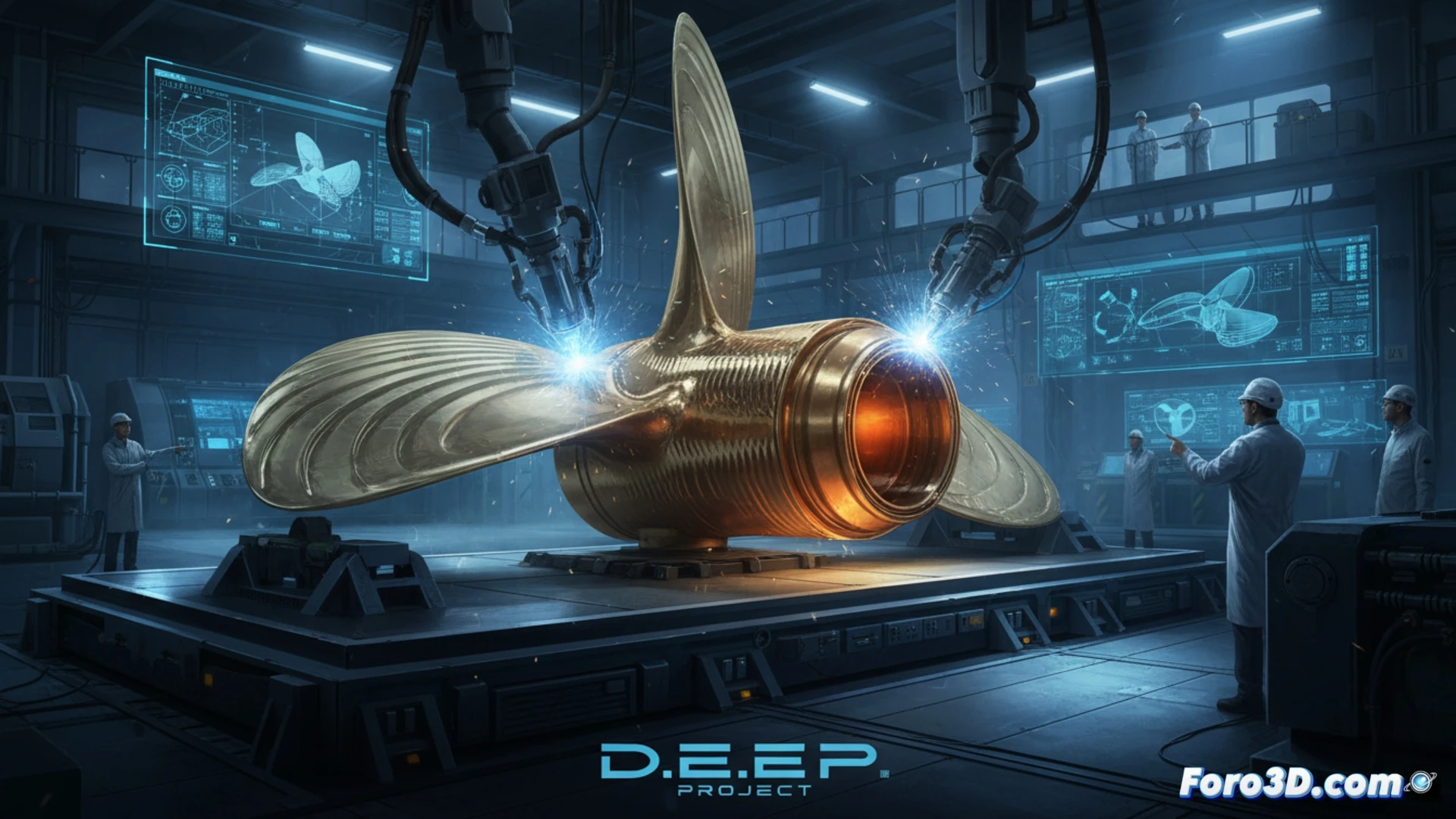
D.E.E.P project 3D prints marine propeller blade section in aluminum-nickel bronze via WAAM
Originally reported by foro3d.com
The D.E.E.P consortium, led by Enki Marine Ltd, has achieved a milestone in additive manufacturing by successfully 3D printing a marine propeller blade section using aluminum-nickel bronze via wire arc additive manufacturing (WAAM). The project partners include TWI for welding technology and Authentise for digital process management. The printed section was validated through non-destructive testing and computational fluid dynamics (CFD) simulations, bringing on-demand production of complex marine components closer to industrial reality. The work targets lighter, more efficient propulsion systems for the naval sector.
This development fits squarely within the industrial-tooling and energy verticals, where WAAM has long promised cost-effective production of large, near-net-shape components without the material waste of subtractive machining. Aluminum-nickel bronze is a demanding material for marine propellers due to its corrosion resistance and mechanical properties, and WAAM's layer-by-layer deposition allows optimized hydrodynamic profiles that are difficult to achieve with conventional casting or forging. The involvement of TWI and Authentise signals a focus on process qualification and digital traceability - prerequisites for any marine certification pathway. The D.E.E.P project is not yet at serial production, but it demonstrates that the aerospace qualification grind pattern is now extending into maritime applications, where certification timelines are similarly long but the potential for weight and fuel savings is substantial.
From an expert standpoint, the practical next step for D.E.E.P is to move from a single blade section to a full-scale propeller assembly and secure a class society certification (e.g., DNV, Lloyd's) for marine use. The consortium must also demonstrate repeatability across multiple builds and prove that WAAM-deposited aluminum-nickel bronze meets fatigue and cavitation resistance standards. For buyers in shipbuilding and offshore energy, this is a proof-of-concept worth tracking, but not yet a procurement option.
Topics