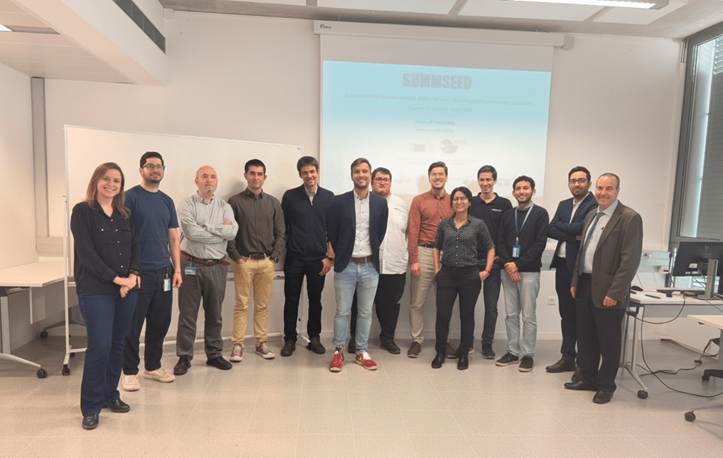
SUMMSEED project launches to develop medium manganese steels for mining via casting and laser-wire DED

Materials
Originally reported by 3D Printing Industry
SUMMSEED, a new European research project funded by the Research Fund for Coal and Steel, has launched to develop medium manganese (medium-Mn) steels tailored for mining and heavy industry, combining industrial casting with laser-wire directed energy deposition (DED). Coordinated by the Technical University of Catalonia (UPC) in Spain, the consortium includes Sandvik, steel producer Sidenor, Meltio (a Spanish manufacturer of wire-laser metal DED systems), Delft University of Technology, CIM UPC, and TU Bergakademie Freiberg. The project will begin with alloy design and laboratory testing, then move to pilot-scale casting trials and the repair of real cone crusher components. Target properties include strength, toughness, and wear resistance for low- to medium-load conditions where Hadfield steels are currently used, with validation involving microstructural, mechanical, and in situ synchrotron characterization.
This initiative sits at the intersection of two underappreciated but economically significant AM vectors: heavy industrial repair via DED and the development of leaner, application-specific alloys. Mining and heavy machinery have long been a quiet but consistent demand vertical for DED-based remanufacturing, where the value proposition is not speed or geometric complexity but extending the service life of high-cost capital equipment. SUMMSEED’s focus on medium-Mn steels as a replacement for traditional Hadfield grades is notable because it targets a specific metallurgical gap: Hadfield steels are well-characterized but rely on relatively high manganese content and are not optimized for DED repair. By designing alloys that work for both casting and laser-wire DED, the project aims to create a circular workflow - cast new parts, then repair worn ones via additive remanufacturing - that reduces critical raw material use and CO₂ emissions. The involvement of Meltio, which has built a commercial position in wire-laser DED for repair and near-net-shape production, gives the project a credible path to industrial deployment beyond the lab.
From an AM industry perspective, SUMMSEED is a textbook example of the long, unglamorous work required to move DED from a niche repair technique into a qualified production and remanufacturing process for heavy industry. The project’s success will depend less on breakthrough metallurgy and more on whether the consortium can deliver repeatable, cost-competitive repair results on real mining equipment - cone crushers, in this case - that meet the wear-life and reliability standards of operators like Sandvik’s customers. If the medium-Mn alloys prove viable in both casting and DED, the practical outcome is a material substitution that lowers alloy cost and environmental footprint without sacrificing performance. That is a concrete, measurable win for a segment of AM that rarely makes headlines but quietly drives adoption in energy, mining, and heavy industrial tooling.