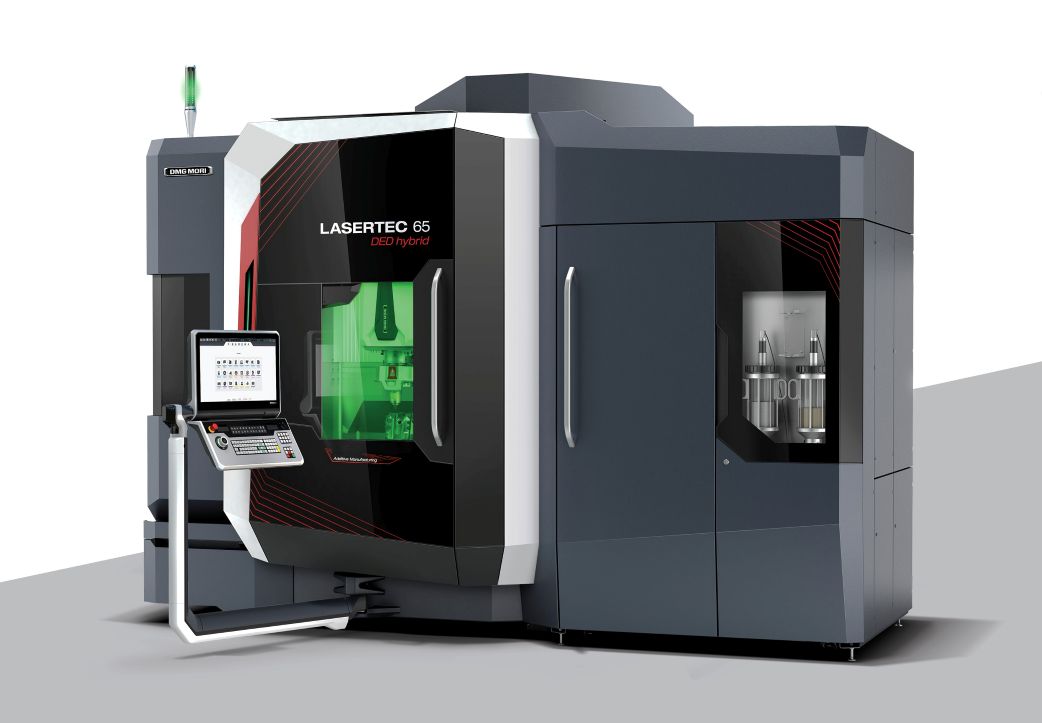
DMG Mori launches LASERTEC 65 DED hybrid 2 with 170% larger build volume and 35% faster deposition

Hardware
Originally reported by 3D ADEPT
DMG Mori has introduced the second generation of its LASERTEC 65 DED hybrid, a production center unveiled at its Pfronten, Germany open house earlier this year. The machine integrates directed energy deposition (DED) via powder nozzle with full 5-axis milling, drilling, turning, grinding, pre-heating, and in-process 3D scanning in a single setup. Build volume has grown 170% to accommodate workpieces up to 840 mm in diameter, while build rate increased 35% through the proprietary MultiJet nozzle that enables true 5-axis material deposition with homogeneous powder distribution regardless of orientation. The system targets cost-per-part reduction for large-format, high-value metal components.
This launch updates the hybrid DED segment, where DMG Mori competes with Mazak's Integrex i-100 AM and Matsuura's Lumex series, though those systems use powder bed fusion rather than DED. The LASERTEC 65 DED hybrid 2 addresses a persistent industrial gap: combining additive and subtractive processes in one workflow eliminates the handling and alignment errors that plague multi-machine approaches. For tooling, mold, and aerospace repair applications, the ability to deposit material and then machine it to final tolerance without unclamping is a direct productivity gain. The 35% build rate improvement moves DED closer to economic viability for mid-volume production runs, not just one-off repairs.
For buyers evaluating hybrid systems, the key metric is not build rate alone but the ratio of deposition time to machining time per part. DMG Mori's integrated measurement loop reduces post-process inspection costs, which often exceed deposition costs in repair workflows. The company must now demonstrate cycle-time benchmarks against standalone DED cells paired with separate machining centers to justify the premium for integration.
Topics