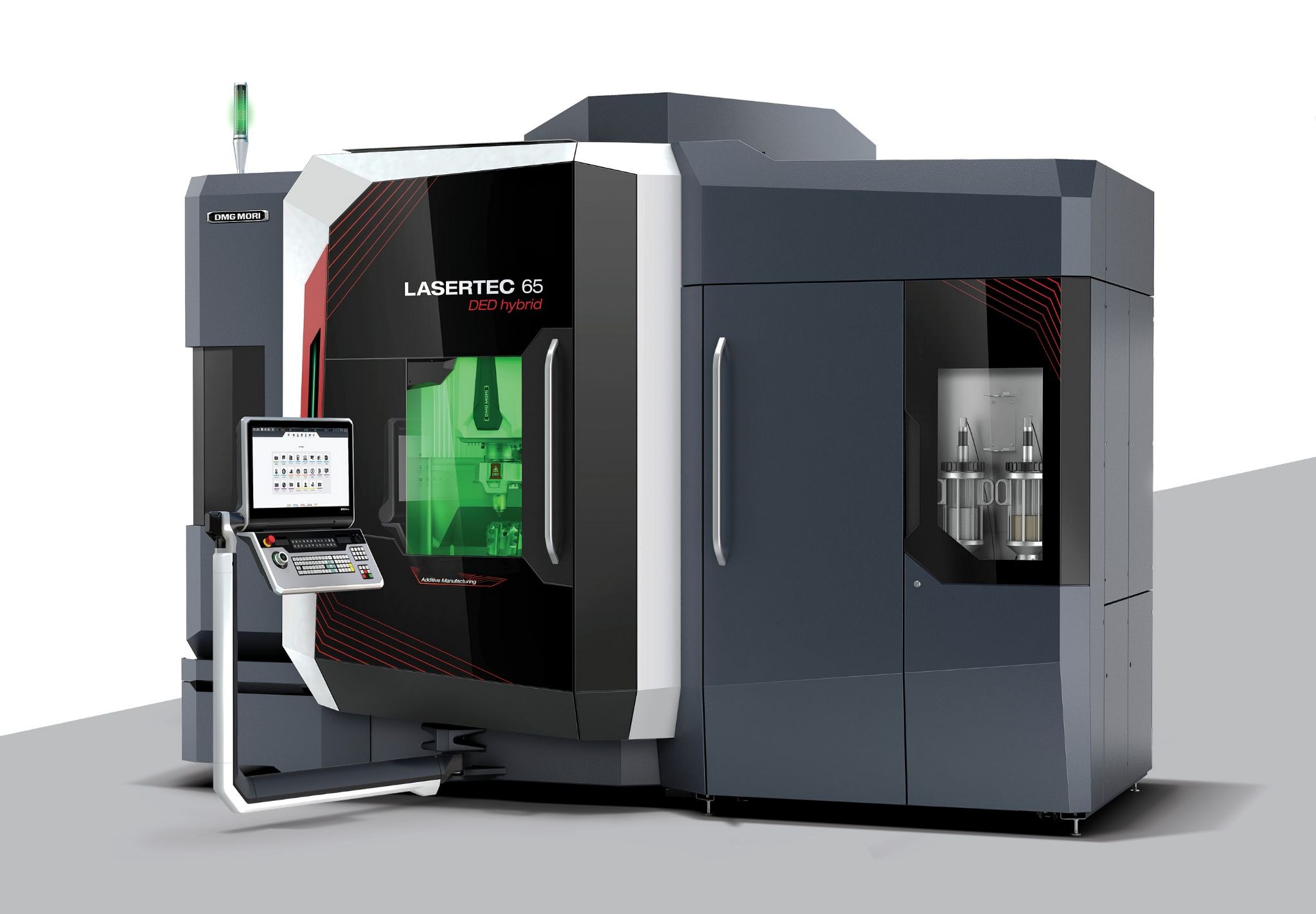
DMG MORI UK launches LASERTEC 65 DED hybrid 2 with 35% faster build rate and 170% larger volume
Originally reported by 3D Printing Industry
DMG MORI UK, the British division of the German-Japanese machine tool conglomerate, has introduced the LASERTEC 65 DED hybrid 2, a second-generation production center that combines directed energy deposition (DED) with 5-axis machining and in-process measurement. Launched at the company's open house in Pfronten, Germany, the system delivers a 35% increase in build rate over its predecessor and a 170% larger working volume, accommodating parts up to 840 mm in diameter by 350 mm tall. The machine integrates additive deposition, milling, drilling, turning, grinding, pre-heating, and 3D scanning in a single setup, running on the CELOS X control environment with Siemens SINUMERIK ONE. A blue laser option enables processing of reflective metals like copper, and the MultiJet nozzle supports 5-axis material deposition with homogeneous powder distribution regardless of flow orientation.
This launch reinforces DMG MORI's position in the hybrid manufacturing segment, where the company competes directly with Mazak's Integrex i-AM series and Matsuura's Lumex line. The LASERTEC 65 DED hybrid 2 addresses a persistent industrial gap: the need to combine additive deposition with subtractive finishing in a single setup to eliminate part transfer errors and reduce lead times for repair and coating applications. The blue laser option is particularly significant for tooling and mold-making verticals, where copper conformal cooling channels can dramatically improve injection molding cycle times. The system's 4-micron positioning accuracy and closed-loop melt pool monitoring bring it closer to the qualification standards required in aerospace and energy repair workflows, though DED remains a niche within the broader metal AM market dominated by LPBF.
For DMG MORI UK, the practical challenge is converting open-house demonstrations into repeat orders from industrial tooling and energy customers who currently rely on separate additive and subtractive processes. The machine's value proposition hinges on reducing total part cost for repair and coating applications, not on displacing LPBF for net-shape production. Buyers should evaluate the system against their specific repair volume and material gradient requirements, particularly for copper and hard-facing applications where the blue laser and MultiJet nozzle provide genuine differentiation.
Topics